What Are Solar Cooling Systems (and How Do They Work)?
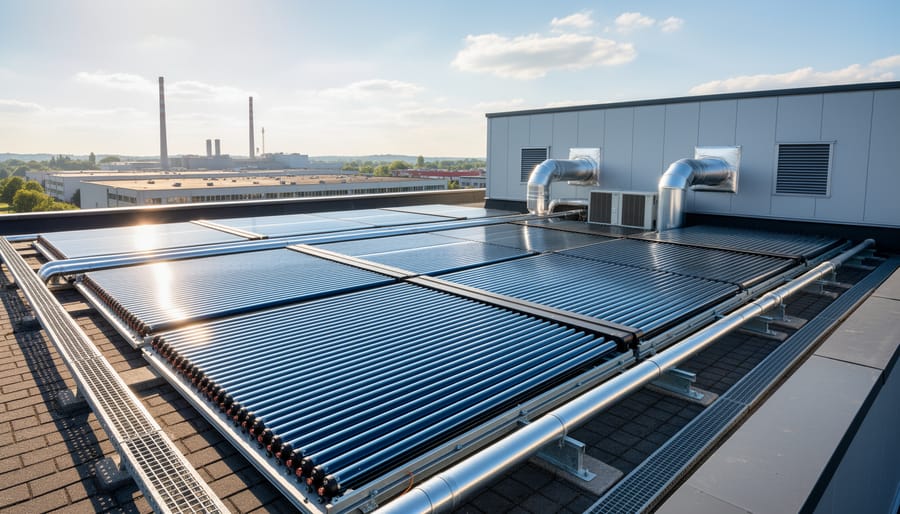
A solar cooling system uses solar energy to power refrigeration or air conditioning, converting heat from the sun into cooling capacity through thermal absorption or photovoltaic-driven compression. While it might seem counterintuitive to use the sun’s heat to cool buildings and industrial processes, this technology turns peak cooling demand into an opportunity: the strongest sunlight delivers the most cooling power precisely when it’s needed most.
For European industries operating energy-intensive facilities, cooling often represents a substantial operational cost. Metal processing plants, mining operations, food production facilities, and manufacturing sites require reliable temperature control year-round, with summer months driving electricity consumption to its highest levels. Traditional cooling systems magnify grid demand during peak hours, resulting in premium electricity rates and significant carbon emissions. Solar cooling systems flip this equation, harnessing abundant summer radiation to reduce both energy costs and environmental impact.
The technology has matured considerably by 2026, with thermal solar cooling systems achieving efficiency gains of 15 to 20 percent over earlier generations, while photovoltaic-powered solutions benefit from declining panel costs and improved inverter technology. European businesses now have access to proven systems tailored to different scales and applications, from small commercial installations to large industrial deployments capable of delivering megawatts of cooling capacity.
This article explains how solar cooling systems function, breaks down the primary technologies available, and examines their practical application in industrial contexts across Europe. You’ll discover the core components that make these systems work, understand the difference between thermal and PV-driven approaches, and learn what implementation considerations matter most for business and industrial facilities. Whether you’re exploring options to reduce cooling costs or seeking sustainable alternatives to conventional HVAC infrastructure, understanding solar cooling technology provides a foundation for informed decision-making.
What Are Solar Cooling Systems?
Solar cooling systems harness energy from the sun to produce cooling for buildings and industrial facilities, reversing the traditional approach where cooling demands peak electricity consumption during hot weather. Unlike conventional air conditioning that relies entirely on grid power to run compressors and chillers, these systems capture solar radiation, either as heat or electricity, and convert it into cooling capacity through specialised thermodynamic processes.
The fundamental advantage lies in the timing alignment: solar energy availability peaks precisely when cooling demand is highest. This synchronicity makes solar cooling particularly valuable for industrial operations in metals processing, mining, and manufacturing where high-temperature environments and equipment require continuous cooling throughout sun-intensive periods.
Two primary pathways exist for converting solar energy into cooling. Solar thermal systems use collectors to heat a working fluid that drives heat-activated chillers through absorption or adsorption cycles. Solar electric systems deploy photovoltaic panels to generate electricity that powers conventional vapor-compression equipment. Both approaches can significantly reduce the operational costs and carbon emissions associated with industrial cooling loads.
- Absorption Cooling
- A heat-driven refrigeration process using a liquid absorbent (typically lithium bromide or ammonia) to produce cooling without mechanical compression. Solar thermal energy provides the heat input to regenerate the refrigerant.
- Solar Thermal Collectors
- Devices that capture and concentrate sunlight to produce high-temperature heat for industrial processes. Evacuated tube or flat-plate collectors deliver thermal energy to drive absorption or adsorption chillers.
- Photovoltaic Cooling
- A system configuration where solar PV panels generate electricity to power standard vapor-compression chillers and auxiliary equipment. Battery storage enables cooling operation beyond daylight hours.
- Coefficient of Performance (COP)
- A ratio measuring cooling efficiency: cooling energy delivered divided by input energy consumed. Solar cooling systems typically achieve COPs between 0.6 and 1.2 for thermal-driven units or 2.5 to 4.0 for PV-powered compression.
- Thermal Energy Storage
- Systems that store excess solar heat or chilled water produced during peak sun hours for use during evening or cloudy periods. This capability extends operational hours and stabilises industrial cooling supply.
For European industries facing rising electricity costs and stricter emissions regulations, solar cooling represents both an immediate operational improvement and a strategic investment in energy independence. The technology has matured from experimental installations to proven industrial-scale deployments across manufacturing sectors where reliable cooling is mission-critical.
How Solar Cooling Systems Work
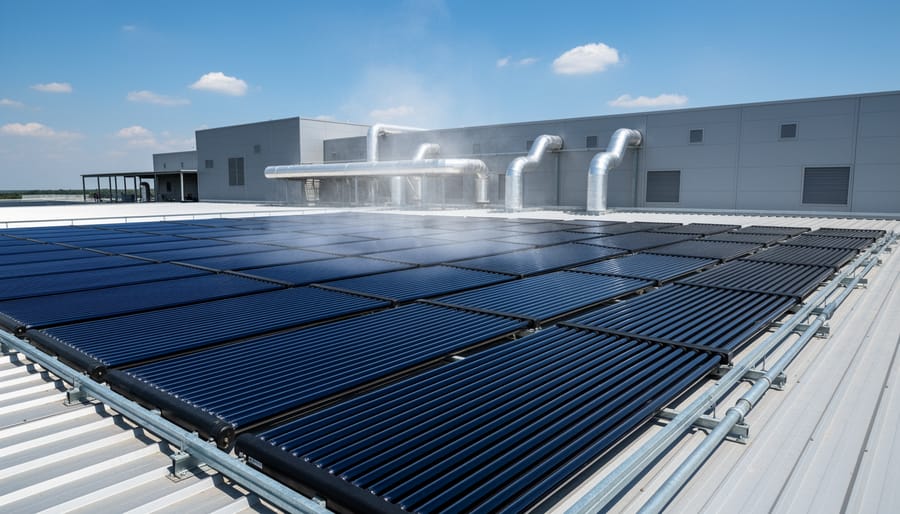
Solar Thermal Cooling Process
Solar thermal cooling operates on a counterintuitive principle: heat drives the cooling process. Unlike conventional systems that consume electricity, solar thermal collectors capture sunlight and convert it to thermal energy, which then powers absorption or adsorption chillers to produce cooling.
The process begins with solar thermal collectors, typically evacuated tube or flat-plate types, heating a working fluid, usually water mixed with glycol, to temperatures between 70°C and 95°C for absorption systems, or as low as 60°C for adsorption chillers. This heated fluid circulates to the chiller unit, where the thermal energy triggers a thermodynamic cycle that produces cooling.
In absorption chillers, the hot fluid heats a refrigerant-absorbent solution, commonly lithium bromide-water or ammonia-water. The heat causes the refrigerant to evaporate from the solution. As this vapor condenses and evaporates in a closed loop, it absorbs heat from the process water or air that needs cooling, creating a chilling effect without mechanical compression.
Adsorption systems follow similar principles but use solid materials like silica gel or zeolite to capture and release refrigerant molecules through heating and cooling cycles. The lower temperature requirements make adsorption particularly suited to industrial operations where consistent mid-grade heat from solar collectors is available.
The beauty of this approach lies in its efficiency: peak cooling demand in industrial facilities typically coincides with peak solar availability, creating natural operational synergy for European manufacturing and processing plants.
Solar Electric Cooling Process
Photovoltaic panels convert sunlight directly into electrical energy, which then powers standard vapor-compression chillers, the same cooling technology found in most conventional refrigeration systems. This approach offers a straightforward pathway for industrial facilities already using electric chillers.
The process begins when PV modules generate direct current electricity from solar radiation. An inverter converts this DC power to alternating current, matching the voltage and frequency requirements of industrial cooling equipment. The electricity drives compressor motors that circulate refrigerant through the cooling cycle, along with condenser fans and circulation pumps that distribute chilled water or coolant throughout the facility.
Battery storage systems integrate seamlessly into this configuration, capturing excess solar generation during peak sunlight hours. These batteries provide power during evening shifts or cloudy periods, enabling continuous cooling operations beyond daylight hours. For energy-intensive industries requiring 24/7 process cooling, hybrid systems combine solar PV with grid connectivity, automatically switching between solar power, stored battery energy, and grid electricity based on availability and cost optimization algorithms.
The electrical pathway proves particularly advantageous for facilities with existing vapor-compression infrastructure. Rather than replacing entire cooling systems, operations simply redirect their power source from the grid to solar-generated electricity. This reduces installation complexity while maintaining familiar equipment and maintenance procedures. Advanced monitoring systems track energy production, consumption patterns, and system efficiency in real time, allowing operators to optimize cooling schedules around solar availability and minimize grid dependence during peak-rate periods.
Types of Solar Cooling Systems
Solar Absorption Cooling Systems
Solar absorption cooling systems harness solar thermal power to drive a heat-activated refrigeration cycle, making them ideal for large-scale industrial applications. These systems use thermal collectors to heat a working fluid, typically to temperatures between 80°C and 120°C, which then powers an absorption chiller. The chiller operates on a lithium bromide-water or ammonia-water solution pair, where heat energy triggers a chemical absorption process that produces a cooling effect without mechanical compression.
Lithium bromide systems excel in process cooling applications, delivering coefficients of performance (COP) ranging from 0.7 to 0.8 in optimal conditions, as demonstrated in a lithium bromide chiller study. Ammonia-water configurations handle lower-temperature cooling demands and prove more robust in variable operating conditions. Both configurations scale effectively for European industrial facilities, particularly where consistent industrial solar heat availability aligns with daytime cooling loads.
The systems integrate thermal storage tanks to extend cooling delivery beyond sunlight hours, maintaining stable temperatures for continuous manufacturing operations. This thermal inertia, combined with the absence of moving parts in the absorption cycle, ensures reliability in demanding industrial environments while eliminating the electricity consumption of conventional vapor-compression chillers.
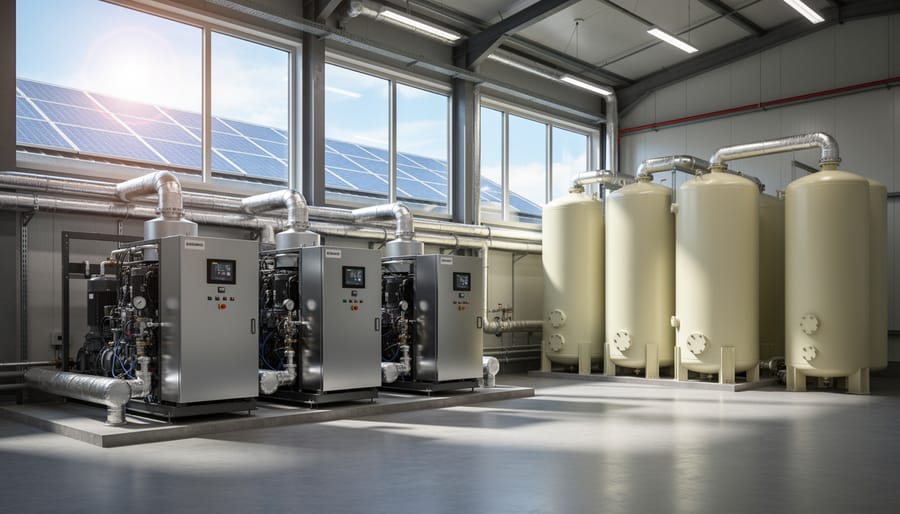
Solar Adsorption Cooling Systems
Solar adsorption cooling systems use solid adsorbent materials such as silica gel or zeolite to capture and release refrigerant vapor in a thermally driven cycle. Unlike absorption systems that rely on liquid chemical solutions, adsorption chillers employ porous solids with high surface areas that physically attract refrigerant molecules when cool and release them when heated. This makes the technology particularly suited to fluctuating solar thermal input and lower-temperature heat sources.
The process begins when solar collectors heat the adsorbent bed to regeneration temperatures, typically between 55°C and 95°C for silica gel regeneration temperatures and slightly higher for zeolite systems. As the bed heats, adsorbed water vapor desorbs and condenses in a separate heat exchanger, releasing thermal energy. When the adsorbent cools, it reabsorbs vapor from an evaporator, creating a cooling effect. This cycle operates without moving mechanical parts in the core sorption beds, reducing maintenance demands.
Adsorption systems deliver reliable performance for continuous industrial operations because they tolerate thermal cycling and can run on lower-grade heat than absorption chillers require. Their modular design allows staged capacity expansion, and dual-bed configurations ensure near-continuous cooling by alternating regeneration and adsorption phases across paired chambers.
Solar Desiccant Cooling Systems
Solar desiccant cooling systems use moisture-absorbing materials, typically silica gel or zeolites, to remove humidity from air, providing cooling through a dehumidification process rather than traditional refrigeration cycles. Solar thermal collectors regenerate the desiccant material by heating it to release absorbed moisture, creating a continuous cycle powered entirely by solar energy.
This technology excels in manufacturing environments where humidity control is critical. Metal fabrication facilities, pharmaceutical production, and food processing operations often require precise moisture levels alongside temperature management. The desiccant wheel rotates between process and regeneration sections: incoming air passes through the desiccant, which absorbs moisture and reduces the air’s dew point. The dried air then cools through evaporative cooling stages, delivering comfortable conditions without mechanical compression.
European manufacturing sites benefit from desiccant systems’ ability to operate effectively at lower solar collector temperatures (50-80°C) compared to absorption chillers. The technology handles high latent cooling loads efficiently, making it suitable for processes generating significant moisture. Combined desiccant-evaporative systems can achieve energy savings of 40-60% versus conventional HVAC in appropriate applications, with minimal moving parts translating to lower maintenance demands and extended operational life in industrial settings.
Photovoltaic-Powered Vapor Compression Systems
Photovoltaic-powered vapor compression systems pair conventional cooling technology with solar electricity generation. Standard vapor compression chillers, the same type used in most commercial buildings, run on electricity supplied by rooftop or ground-mounted PV arrays. This approach leverages mature, reliable cooling equipment while eliminating or reducing grid dependence.
The system works straightforwardly: solar panels convert sunlight into DC electricity, an inverter transforms it to AC power, and the chiller operates like any grid-connected unit. When solar production exceeds cooling demand, excess electricity can charge battery banks or feed back into the grid where net metering applies.
Battery integration transforms these systems into 24/7 solutions. Industrial facilities operating multiple shifts benefit from stored solar energy during evening hours or cloudy periods. Hybrid configurations combine battery storage with grid connection, drawing from the most economical source at any moment while maintaining uninterrupted cooling capacity.
This configuration offers significant advantages for European industries: simpler maintenance than thermal systems, compatibility with existing HVAC infrastructure, and scalability from small process cooling to large facility-wide installations. The vapor compression pathway suits operations requiring precise temperature control and rapid response to variable cooling loads.
Industrial Applications of Solar Cooling
European industries have embraced solar cooling systems as a practical solution for managing the substantial thermal loads generated by energy-intensive operations. The technology proves particularly valuable in sectors where conventional cooling consumes significant portions of operational budgets and contributes heavily to carbon emissions.
Metal processing facilities represent one of the most promising applications for solar cooling technology. Steel mills, aluminum smelters and metal fabrication plants generate enormous heat during production processes that require continuous temperature management. Solar thermal cooling systems can handle the constant demand for process cooling while simultaneously reducing reliance on grid electricity. The European industry shift toward renewable energy has accelerated adoption in these sectors, where cooling requirements align well with peak solar availability during production hours.
Mining operations across Europe face unique cooling challenges in both surface and underground facilities. Equipment cooling, ventilation systems and worker comfort areas require reliable temperature control in often remote locations. Solar absorption chillers paired with thermal storage enable round-the-clock cooling without extending electrical infrastructure. This integration complements solar-powered machinery already operating in modern mining sites, creating comprehensive renewable energy ecosystems.
Industrial applications span multiple critical areas:
- Metal processing facilities requiring precise temperature control during smelting, casting and heat treatment operations
- Mining equipment cooling and underground ventilation systems in remote locations
- Warehouse climate control for temperature-sensitive inventory storage
- Manufacturing process cooling for chemical production, food processing and pharmaceutical operations
- Data center cooling for server farms and industrial computing facilities
- Cold storage facilities maintaining consistent temperatures for logistics and distribution
Manufacturing facilities benefit significantly from solar desiccant cooling in production environments where humidity control matters as much as temperature management. Pharmaceutical production, electronics assembly and food processing operations require stable climatic conditions that solar cooling delivers efficiently. Hybrid solar systems combining photovoltaic power with thermal cooling provide flexibility for operations with varying load profiles throughout production cycles.
INOX Solar supports industrial-scale implementations through comprehensive project management that addresses the unique requirements of each sector. From initial feasibility studies through system integration and ongoing optimization, the company delivers complete solutions tailored to specific cooling demands, operational patterns and existing infrastructure. This support proves essential for industries transitioning to sustainable cooling without disrupting critical operations or compromising temperature control reliability.
Benefits for European Industries
European industries adopting solar cooling systems gain significant operational and financial advantages that extend well beyond basic energy savings. The measurable benefits span cost reduction, regulatory alignment, and strategic energy positioning for manufacturing, metals processing, and mining operations across the continent.
Energy cost reduction stands as the most immediate benefit, with industrial facilities typically achieving 30-60% lower cooling energy expenses depending on system design and operational hours. Manufacturing plants and metals processors running continuous cooling operations see particularly strong returns, as solar-assisted systems offset peak-demand charges when electricity prices are highest. The savings compound over time as conventional energy costs rise while solar production costs remain fixed after installation. For facilities integrating 3-phase inverters with photovoltaic-powered cooling systems, the electricity generated feeds directly into high-power industrial chillers, maximizing the economic value of every kilowatt-hour produced.
Carbon footprint mitigation addresses Europe’s increasingly stringent environmental requirements. Solar cooling systems dramatically reduce Scope 2 emissions from purchased electricity, helping industrial facilities align with the EU’s carbon neutrality goals for 2050 and interim 2030 targets. Mining operations and energy-intensive manufacturing plants demonstrate measurable emissions reductions, supporting corporate sustainability commitments and improving environmental reporting metrics that matter to investors and stakeholders.
Regulatory compliance becomes simpler as environmental standards tighten across European jurisdictions. Facilities with solar cooling infrastructure position themselves ahead of anticipated carbon pricing mechanisms and renewable energy mandates. Many countries offer accelerated permitting, tax incentives, or grant support for industrial renewable installations, improving project economics while ensuring regulatory alignment.
Energy independence reduces vulnerability to grid disruptions and price volatility. Industrial sites with solar-powered cooling maintain operational continuity during supply constraints and insulate themselves from geopolitical energy market fluctuations that have affected European industries in recent years. Thermal storage integration allows facilities to run cooling systems during evening shifts or cloudy periods, extending the practical independence beyond direct sunlight hours.
Long-term resilience and competitiveness improve as solar cooling systems lock in predictable energy costs over 20-25 year operational lifespans. European industries that invest now secure cost advantages over competitors still dependent on conventional grid power, while building the sustainable infrastructure that customers and partners increasingly expect from supply chain participants.
Key Components and Infrastructure
A robust solar-assisted industrial cooling installation comprises several interconnected components, each playing a critical role in converting solar energy into reliable cooling capacity for demanding industrial operations.
At the foundation of any system lies the solar energy capture technology. Solar thermal collectors, whether flat-plate, evacuated tube, or concentrating types, gather heat for thermally-driven cooling systems, while photovoltaic arrays generate electricity for compression-based chillers. The choice depends on your cooling technology and climate conditions, with thermal collectors typically achieving 50-70% efficiency in converting sunlight to usable heat.
The cooling machinery itself forms the system’s heart. Absorption or adsorption chillers transform thermal energy into cooling effect, while vapor-compression units driven by solar electricity provide cooling through conventional refrigeration cycles. Industrial-scale units range from 100 kW to several megawatts of cooling capacity, sized to match process requirements and solar resource availability.
Essential supporting infrastructure includes:
- Solar thermal collectors or photovoltaic arrays matched to cooling load and available roof or ground space
- Absorption, adsorption, or compression chillers sized for peak and average cooling demands
- Thermal energy storage tanks holding hot water or chilled water to buffer supply and demand mismatches
- Cooling towers and dry coolers for heat rejection from the cooling cycle
- Heat exchangers connecting solar loops, chiller circuits, and process cooling distribution
- Advanced control and monitoring systems optimizing performance across varying solar conditions
- Grid connection infrastructure and backup generators ensuring continuous operation during low-solar periods
Thermal storage tanks deserve particular attention in industrial settings. These insulated vessels store hot water from solar collectors or chilled water from cooling units, enabling cooling delivery during cloud cover or nighttime shifts. Proper sizing, typically 50-100 liters per kW of cooling capacity, extends solar utilization from 6-8 hours of direct sunshine to 12-16 hours of cooling availability.
Control systems integrate weather forecasting, cooling demand prediction, and real-time optimization algorithms. They manage collector operation, storage charging, chiller sequencing, and backup system activation to maximize solar fraction while maintaining process temperatures within tight tolerances.
INOX Solar delivers turnkey support encompassing component selection, system integration engineering, installation supervision, and commissioning. This comprehensive approach ensures that every element, from collector mounting structures to control cabinet wiring, works together as an optimized cooling solution rather than a collection of individual parts.
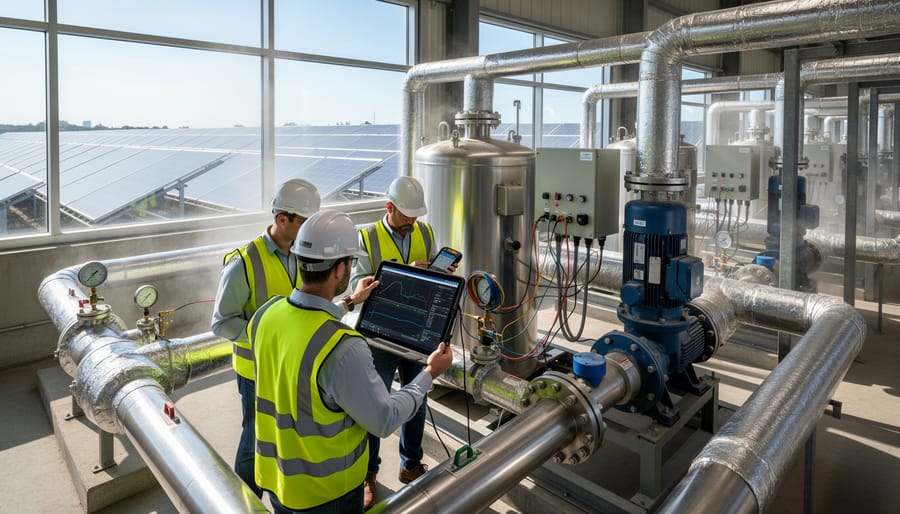
Implementation Considerations
Deploying a solar cooling system in an industrial facility requires careful upfront planning to ensure the installation delivers reliable performance and meets your operational needs. Start with a thorough site assessment that evaluates available roof or ground space for solar collectors or PV arrays, local solar irradiance levels, shading patterns throughout the year, and structural capacity to support mounting equipment. European industrial sites often face space constraints or complex layouts, so identifying optimal placement early prevents costly redesigns.
Next, conduct a detailed cooling load analysis. Calculate your facility’s peak and average cooling demands across seasons, factoring in production schedules, process heat loads, and ambient temperature variations. This analysis determines whether solar thermal or PV-driven systems best match your load profile. Operations with steady daytime cooling needs align well with direct solar thermal absorption systems, while facilities requiring round-the-clock cooling benefit from PV systems paired with battery storage or hybrid configurations that switch between solar and grid power.
System sizing involves balancing solar capacity with cooling output and backup requirements. Oversizing can inflate capital costs without proportional savings; undersizing compromises reliability during high-demand periods. Engineers typically design systems to cover 50-70% of annual cooling loads with solar energy, using conventional backup for peaks and nighttime operation. Thermal storage tanks or battery banks extend solar contribution beyond daylight hours, improving return on investment.
Integration with existing infrastructure presents both technical and operational challenges. Solar cooling equipment must interface with current HVAC systems, control networks, and electrical distribution. Retrofitting older facilities may require upgrading switchgear, adding monitoring systems, or modifying ductwork and piping. Plan for minimal disruption to production during installation phases.
INOX Solar provides comprehensive project management support throughout implementation, coordinating site surveys, engineering design, equipment procurement, and installation oversight. Their team handles permitting, grid connection approvals, and compliance with European energy regulations. Post-installation, they offer commissioning services to optimize system performance, train facility staff, and establish maintenance protocols. This turnkey approach reduces the complexity and risk for industrial operators adopting solar cooling for the first time, ensuring projects move from concept to operation smoothly and efficiently.
Frequently Asked Questions
Industrial decision-makers considering solar cooling systems often face similar questions about performance, costs, and practical implementation. Understanding these common concerns helps businesses evaluate whether this technology aligns with their operational needs and sustainability goals.
Do solar cooling systems work effectively in cloudy European climates?
Yes, modern solar cooling systems perform well across Europe, including regions with variable weather. Solar thermal systems can utilize diffuse radiation even on overcast days, while hybrid configurations with thermal storage or battery backup ensure continuous cooling capacity regardless of immediate solar availability.
What maintenance do industrial solar cooling systems require?
Maintenance demands are relatively modest, typically involving annual inspections of solar collectors, cleaning panels twice yearly, checking refrigerant levels in chillers, and monitoring control systems. Most industrial installations require 10-15 hours of maintenance annually, with major component servicing every 3-5 years.
What is the typical payback period for industrial solar cooling installations?
Payback periods for European industrial applications generally range from 5 to 10 years, depending on cooling load intensity, regional energy prices, and available incentives. Operations with high cooling demands and extended operating hours typically see faster returns, particularly when factoring in carbon pricing and energy cost inflation.
Can solar cooling integrate with our existing industrial cooling infrastructure?
Most solar cooling systems can supplement or retrofit existing cooling infrastructure without complete replacement. Integration options include parallel operation with conventional chillers, pre-cooling heat rejection systems, or phased replacement as existing equipment reaches end-of-life, allowing gradual capital deployment.
Beyond these fundamental questions, businesses should assess how thermal or battery storage options can extend cooling availability into evening and night shifts. Storage systems allow solar energy captured during peak sunshine to drive cooling operations during off-sun hours, ensuring 24/7 process support. For growing operations, modular solar cooling systems offer excellent scalability. Additional collector arrays or PV capacity can be installed as cooling demands increase, allowing businesses to match system expansion with production growth rather than over-investing upfront. This flexibility makes solar cooling particularly attractive for facilities planning capacity increases or operational expansion over the coming years.
how it works
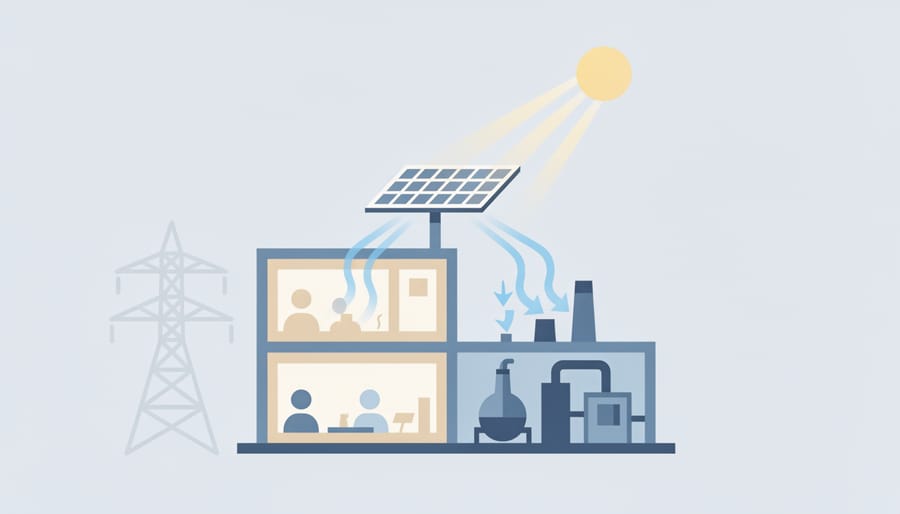
Solar cooling systems harness the sun’s energy to drive refrigeration cycles, creating a counterintuitive but elegant solution: using heat to produce cold. The process begins with solar collectors, either photovoltaic panels or thermal collectors, capturing sunlight and converting it into usable energy.
In thermal-driven systems, solar collectors heat a transfer fluid to temperatures between 70°C and 95°C. This thermal energy powers absorption or adsorption chillers, which use heat instead of electricity to drive the cooling cycle. The heated fluid triggers a chemical reaction in a refrigerant solution, causing evaporation that absorbs heat from the space being cooled. The refrigerant then condenses, releasing heat outdoors, and the cycle repeats.
Photovoltaic-powered systems take a different route. Solar panels generate electricity that runs conventional vapor-compression chillers, the same technology used in standard air conditioning, but powered by renewable energy. These systems can include battery storage to maintain cooling during cloudy periods or nighttime operations.
Both approaches reduce reliance on grid electricity and fossil fuels, making them particularly valuable for continuous industrial operations where cooling demands are substantial and predictable.
Types or components
A complete solar-assisted industrial cooling system integrates several critical components that work together to convert solar energy into reliable cooling capacity. At the core, solar collectors, either photovoltaic panels or thermal collectors, capture and convert sunlight. Thermal systems use flat-plate or evacuated-tube collectors to heat a transfer fluid, while PV systems generate direct current electricity.
The chiller unit represents the second essential element. Absorption and adsorption chillers operate on heat input from thermal collectors, using refrigerant pairs like lithium bromide-water. Alternatively, vapor-compression chillers run on electricity from PV panels, requiring inverters to convert DC to AC power.
Thermal storage tanks buffer energy supply, storing heated fluid or chilled water to maintain cooling during cloudy periods or overnight. Control systems and sensors manage fluid flows, temperatures, and system performance, optimizing efficiency across varying solar conditions.
For industrial applications, backup systems, either grid connections or auxiliary heaters, ensure continuous operation during extended low-sunlight periods. Heat exchangers, pumps, and distribution networks complete the infrastructure, delivering cooling to process equipment or facility spaces.
Solar cooling systems represent a transformative opportunity for European industries seeking to reduce energy costs while meeting increasingly stringent sustainability requirements. The technology has matured beyond experimental applications into proven solutions capable of delivering reliable, year-round cooling for energy-intensive operations. For metals processing, mining facilities, and manufacturing plants across Europe, the combination of abundant solar resources and advanced cooling technologies creates a compelling pathway toward operational efficiency and carbon reduction.
The financial case strengthens each year as conventional energy prices remain volatile and renewable energy technologies become more cost-effective. Industries that integrate solar-assisted cooling systems today position themselves advantageously for the regulatory landscape of 2026 and beyond, when carbon pricing mechanisms and emissions reporting will likely intensify. These systems don’t merely reduce costs, they enhance energy resilience and demonstrate commitment to environmental stewardship that increasingly influences stakeholder relationships and market positioning.
INOX Solar’s comprehensive project support removes many traditional barriers to adoption. From initial feasibility studies and system design through equipment procurement, installation coordination, and long-term optimization, the end-to-end approach ensures that industrial operators can focus on core business activities while transitioning to cleaner cooling solutions. This integrated support model addresses both technical complexity and project risk, making solar cooling accessible even for organizations without specialized renewable energy expertise.
For European industries evaluating their cooling infrastructure in 2026, solar-assisted systems deserve serious consideration as part of broader decarbonization and efficiency strategies. The technology works, the economics improve steadily, and the support ecosystem has matured to enable successful implementation at industrial scale.
Leave a Reply