What Is the Polar-Region Definition in Solar Energy?
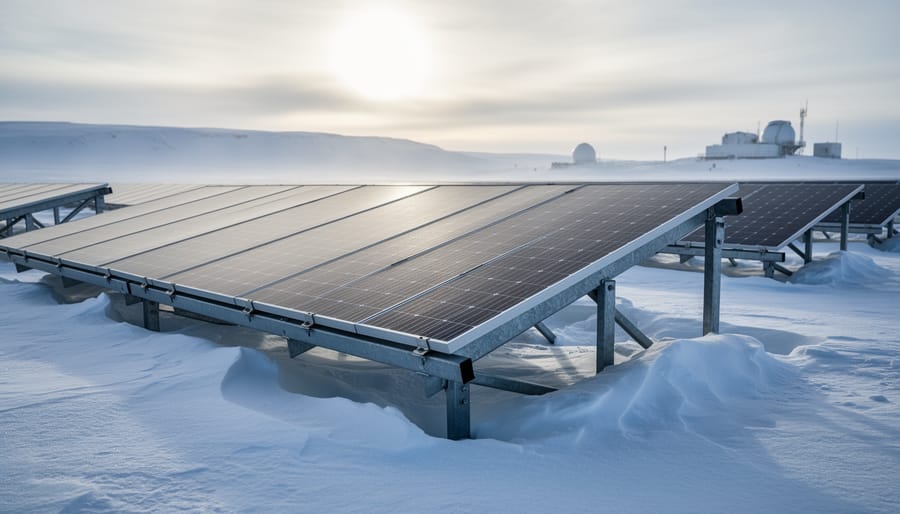
A polar region is any geographic area within the Arctic or Antarctic Circles, roughly above 66.5° latitude north or below 66.5° latitude south, characterized by extreme seasonal light variation, sub-zero temperatures for much of the year, and unique solar irradiance patterns. In solar technology, this definition matters because these zones present distinct challenges and opportunities that fundamentally change how photovoltaic systems are designed, installed, and operated.
Solar deployment in polar regions demands specialized understanding. Traditional design assumptions break down when panels must capture low-angle sunlight for months, endure temperatures that can plunge below -40°C, and survive snow loads that would overwhelm standard mounting systems. Yet these regions also offer unexpected advantages: continuous daylight during summer months, enhanced albedo from reflective snow and ice surfaces, and cooler operating temperatures that boost panel efficiency when the sun does shine.
For European energy professionals, Arctic solar projects in Scandinavia and northern Russia demonstrate how polar-adapted systems perform in real-world conditions. Understanding what qualifies as a polar region helps engineers select appropriate inverters, specify temperature-rated components, and calculate realistic energy yields.
This article provides a comprehensive breakdown of polar region characteristics, explains how solar technology operates under extreme latitude conditions, identifies the specialized components required for reliable performance, and examines practical applications across research stations, remote communities, and commercial installations where innovation meets sustainability in Earth’s most demanding environments.
What the Polar-Region Definition Means for Solar Applications
Polar regions are formally defined by their proximity to Earth’s geographic poles, with boundaries typically set at the 66.5° Arctic boundary in the north and the Antarctic Circle at 66.5° south latitude. These invisible lines mark where the sun fails to rise for at least one full day in winter and never sets for at least one day in summer. For solar energy deployment, this geographic definition translates into operational realities that no other climate zone presents.
Understanding these fundamental polar characteristics is essential for anyone considering solar installations at extreme latitudes:
- Arctic Circle
- The northern polar boundary at 66.5° north latitude, encompassing parts of Norway, Sweden, Finland, Russia, Alaska, Canada, and Greenland where polar conditions begin.
- Antarctic Circle
- The southern counterpart at 66.5° south, defining the continental Antarctic region and surrounding waters where solar systems must withstand the planet’s most extreme environment.
- Polar Day and Night
- Extended periods of continuous daylight in summer (enabling 24-hour generation) and complete darkness in winter (requiring full reliance on stored energy or backup power).
- Albedo Effect
- The high reflectivity of snow and ice surfaces, which can increase solar irradiance on panels by 15-25% through reflected light but also creates glare and cleaning challenges.
- Permafrost
- Permanently frozen ground that complicates foundation design for mounting systems and can shift with temperature variations.
The climate definition matters because temperatures routinely drop below -40°C, wind speeds exceed 160 km/h during storms, and precipitation arrives as snow that accumulates on panels and structures. These aren’t occasional extremes but baseline operating conditions. Solar systems designed for temperate European climates will fail in polar regions without specialized components rated for sustained cold, reinforced to handle wind and snow loads, and equipped with thermal management to keep electronics functional. The six-month darkness cycle alone demands battery capacity and system sizing calculations fundamentally different from standard grid-tied installations, where daily or seasonal storage suffices.
How Solar Energy Works in Polar-Region Conditions
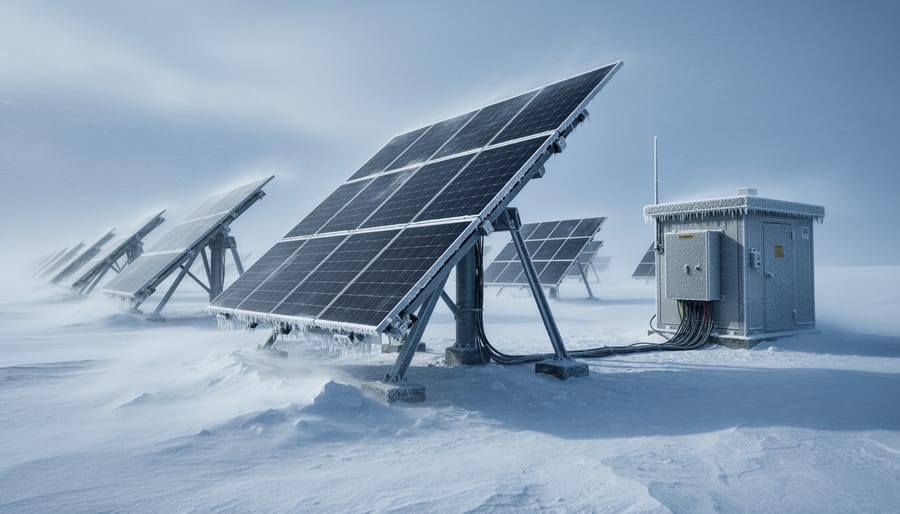
Solar energy systems in polar regions operate under fundamentally different conditions than those in temperate or tropical climates, driven by extreme seasonal light cycles and temperature variations. During summer months, locations above the Arctic and Antarctic Circles experience near-continuous daylight for weeks or months, allowing photovoltaic panels to generate electricity around the clock. A research station at 70° latitude might see 24-hour sunlight from May through July, producing power even at midnight when the sun remains above the horizon. This extended generation window can offset the complete darkness of winter, when the same location receives no direct sunlight for months.
The physics of solar performance at high latitudes presents both advantages and complications. Lower temperatures boost output because photovoltaic cells operate more efficiently in cold conditions, a panel rated at 300 watts in standard test conditions (25°C) might produce 320-330 watts at -20°C due to reduced resistance in the semiconductor materials. Additionally, high-albedo surfaces like snow and ice reflect 50-90% of incoming light, effectively increasing the irradiance hitting panels from multiple angles and further enhancing energy capture during daylight periods.
However, winter darkness necessitates substantial battery storage capacity or hybrid systems combining solar with diesel generators or wind turbines to maintain power through months without sun. A typical Antarctic research station might need battery banks sized for 90-120 days of autonomy, adding significant cost and complexity. Snow accumulation presents another operational challenge, panels must be installed at steep angles (60-70° from horizontal) to encourage snow shedding, and heated frames or manual clearing become necessary after heavy storms. Extreme weather compounds these issues: wind speeds exceeding 150 km/h, temperatures below -40°C, and ice formation can damage equipment, reduce access for maintenance, and require specialized cold-rated components throughout the system.
Components and Technologies for Polar Solar Systems
Panel Technology for Extreme Cold
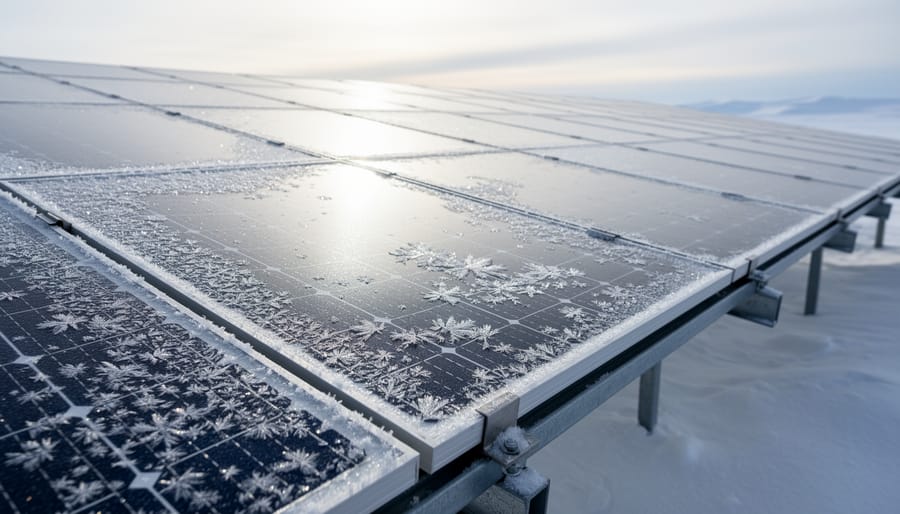
Standard photovoltaic panels fail in polar conditions because conventional cell materials and adhesives crack at sustained temperatures below -40°C. Polar-rated panels use silicone-based encapsulants instead of EVA (ethylene-vinyl acetate), preventing brittleness and delamination during multi-month cold exposure. Cell interconnects are reinforced with flexible low-temperature solder alloys that accommodate thermal contraction without fracturing connections.
Anti-reflective coatings on polar panels are engineered for oblique light angles typical of high latitudes, maximizing photon capture when the sun never rises far above the horizon even at noon. Multi-layer coatings reduce reflection at 15-30° incident angles rather than the 45-90° range optimized for temperate climates, recovering 3-5% additional energy yield in winter months.
Frame design addresses extreme snow and wind loads. Frameless glass-on-glass constructions eliminate aluminum frames that create weak points for ice buildup and mechanical stress. When frames are necessary, reinforced anodized aluminum with wider cross-sections and corner brackets rated to withstand sustained 150 km/h winds and 600 kg/m² snow loads prevent warping and structural failure during polar storms.
Energy Storage Solutions
Energy storage in polar regions must withstand months of darkness when generation halts entirely. Lithium iron phosphate (LiFePO4) batteries have emerged as the preferred chemistry because they retain 80-90% capacity down to -20°C and tolerate thousands of charge cycles. Advanced absorbent glass mat (AGM) lead-acid variants offer a lower-cost alternative for installations where weight matters less, though they lose efficiency faster below -15°C.
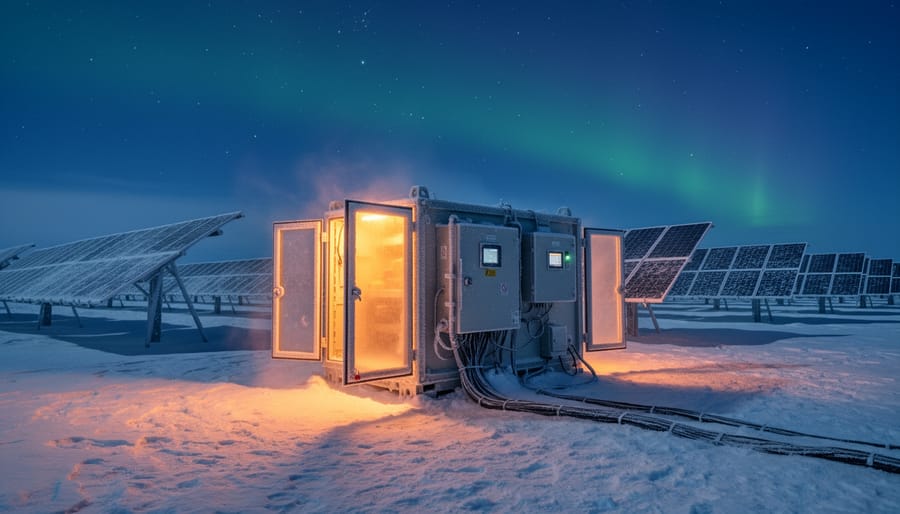
Thermal management separates functional systems from failed ones. Insulated battery enclosures with trace heating maintain internal temperatures above -5°C, consuming 2-5% of stored energy but preventing capacity loss and damage. Smart thermal controllers activate heating only when temperatures drop below safe thresholds, balancing protection against energy waste.
Capacity sizing must account for the polar energy deficit. A research station at 78°N latitude experiences roughly 120 days of near-total darkness, requiring battery banks sized for 4-6 months of full load plus a 30% safety margin. This typically translates to 3-5 times the storage capacity used in temperate climates, making accurate load profiling and conservative sizing critical during the design phase.
Where and How Polar Solar Technology Is Used Today
Polar solar technology today powers critical operations across some of the planet’s harshest environments, from Antarctic research bases to remote Arctic communities. These installations demonstrate how specialized solar systems overcome extreme conditions to deliver reliable energy where conventional infrastructure remains impractical or impossible.
- Antarctic research stations: Year-round power supplementing diesel generators at bases including Concordia Station and Rothera Research Station, reducing fuel transport costs and environmental impact
- Arctic mining operations: Off-grid installations supporting mineral extraction in northern Sweden, Finland, and Russia, where remote solar systems eliminate costly fuel deliveries during accessible summer months
- Indigenous settlements: Community-scale arrays in Alaska, northern Canada, and Greenland providing sustainable power and reducing reliance on diesel generators
- Telecommunications infrastructure: Solar-powered repeater stations and satellite ground facilities maintaining connectivity across Arctic regions
- Environmental monitoring equipment: Autonomous weather stations, wildlife cameras, and climate research instruments operating continuously throughout polar seasons
European Arctic projects showcase particular innovation in system design and deployment logistics. Norway’s Svalbard archipelago hosts numerous solar installations supporting research and tourism infrastructure. Finnish Lapland sees growing commercial adoption for off-grid cabins and resource exploration. Sweden’s northern mining sector increasingly integrates solar to reduce operational costs.
Companies like INOX Solar bring comprehensive project management expertise to these challenging deployments. Success requires coordinating specialized equipment transport, managing installation windows during brief summer accessibility, and establishing remote monitoring capabilities. This integrated approach proves essential in environments where a single equipment failure or logistical oversight can compromise an entire season’s operations. The expanding role of polar solar installations directly shapes Europe’s Arctic future supporting sustainable development in regions previously dependent on imported fossil fuels.
Planning Considerations for Polar Solar Installations
Successful polar solar installations depend on thorough upfront planning that accounts for the region’s unique constraints. Start by modelling seasonal energy yield across the full year: summer months may deliver near-continuous generation during 24-hour daylight, while winter darkness can eliminate production entirely for weeks or months. Size your battery bank or hybrid backup system to bridge these gaps, factoring in a safety margin for unexpected load increases or equipment downtime.
Design every component for worst-case conditions, not average weather. Mounting structures must withstand hurricane-force winds and the static load of metres of accumulated snow. Panel tilt angles should facilitate natural snow shedding while capturing low-angle sun effectively, and all electronics need cold-rated specifications verified to your site’s historical temperature extremes. Lessons from high-altitude solar deployments translate well here: ruggedized hardware and redundant critical systems are non-negotiable.
Plan maintenance and equipment delivery around brief accessible windows, typically summer months when sea ice recedes or overland routes become passable. Stock spare parts on-site for components likely to fail, since emergency replacements can take months. Remote monitoring systems allow technicians to diagnose issues from afar and prioritize trips.
Regulatory compliance is critical. Many polar regions fall under strict environmental protection frameworks, Antarctica requires permits under the Antarctic Treaty System, while Arctic sites must navigate national sovereignty rules and indigenous land agreements. Factor in these timelines early.
Is solar energy viable in polar regions despite winter darkness?
Yes, when paired with adequate battery storage or hybrid systems. Summer generation can produce surplus energy to offset winter deficits in annual calculations.
What drives the higher cost of polar solar projects?
Logistics, specialized cold-rated equipment, reinforced mounting systems, and limited maintenance windows all add expense. Comprehensive project support mitigates these challenges.
How does snow affect solar panel performance in polar regions?
Snow accumulation blocks light and reduces output, but steep tilt angles and dark panel surfaces promote natural shedding. Manual clearing may still be required during heavy snowfall periods.
Comprehensive project support from experienced providers, covering feasibility studies, component selection, logistics coordination, and commissioning, dramatically improves outcomes in these unforgiving environments.
Understanding the polar-region definition, typically zones above 66.5° latitude experiencing extreme cold, prolonged darkness, and unique light cycles, is fundamental to selecting and deploying solar technology that can withstand and thrive in the world’s harshest environments. These geographic and climatic parameters directly shape equipment choices, from cold-rated panels and ruggedized mounting systems to battery storage engineered for sub-zero performance. As demand grows for sustainable energy at research stations, remote mining sites, and indigenous communities across the Arctic and Antarctic, specialized solar solutions have evolved from niche experiments into proven technologies supporting critical operations where conventional grid infrastructure is impossible.
INOX Solar brings comprehensive project support to these challenging installations, combining technical expertise with logistical coordination to deliver reliable solar systems in extreme latitudes. Whether planning a research facility in Svalbard, powering telecommunications infrastructure in northern Scandinavia, or supporting scientific monitoring across the Arctic, we work with clients from initial feasibility and design through procurement, installation, and long-term maintenance. Our commitment to innovation and hands-on support ensures that polar solar projects succeed where conditions test equipment and resolve alike, advancing sustainability in the regions that demand it most.
Leave a Reply