Why Europe’s Three Major Mountain Ranges Are Leading the Solar Revolution
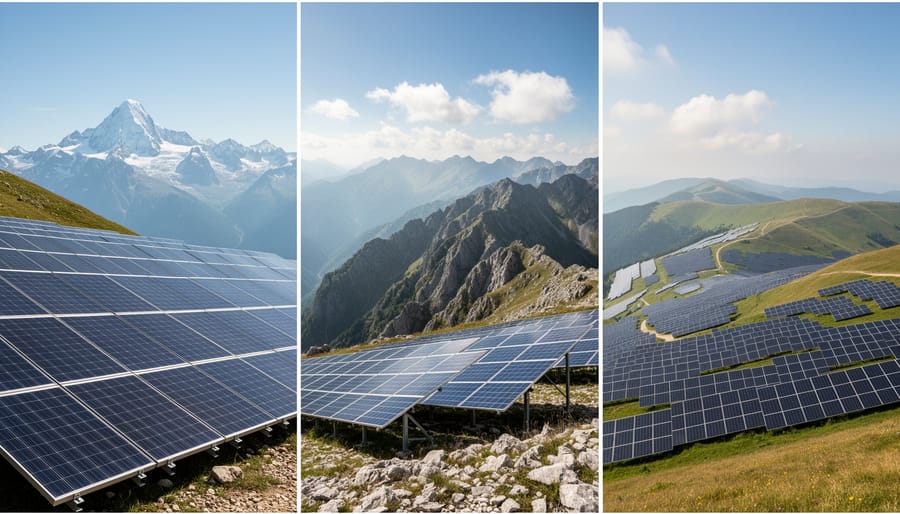
Europe’s three major mountain ranges, the Alps, the Pyrenees, and the Carpathians, present distinct opportunities and challenges for solar energy installations, each shaped by altitude, climate, and terrain characteristics specific to their geography. While mountainous regions traditionally face concerns about shading, snow load, and installation complexity, modern solar technology combined with strategic site selection has proven these locations can deliver reliable energy production with proper planning and regional expertise.
The Alps, spanning eight countries and reaching elevations above 4,800 meters, offer exceptional solar irradiance at higher altitudes where thinner atmosphere reduces energy loss. The Pyrenees, forming a natural border between France and Spain, provide more stable weather patterns on their southern slopes, creating predictable generation profiles. The Carpathians, stretching across Central and Eastern Europe, present lower elevations but wider installation areas with growing grid infrastructure support.
Understanding range-specific conditions matters because solar viability shifts dramatically with aspect, elevation, and local microclimates. South-facing installations in the Alps can outperform lowland sites during winter months due to increased reflection from snow cover and clearer skies above cloud layers. Pyrenean installations benefit from Mediterranean influences on southern exposures, while Carpathian projects often encounter more favorable installation costs alongside developing energy markets.
This article examines the technical realities, opportunities, and proven solutions for solar deployment across these three ranges, helping European businesses and homeowners evaluate whether mountain locations align with their energy goals. The insights ahead will unlock Europe’s solar potential in regions once considered marginal, demonstrating how elevation and terrain transform from obstacles into competitive advantages with the right approach and comprehensive project support.
The Alps: Europe’s Solar Testing Ground for Extreme Conditions
High-Altitude Advantages That Offset the Challenges
Mountains present a counterintuitive solar advantage that compensates for their harsh conditions. At 2,000 metres above sea level, solar panels receive roughly 10 per cent more irradiance than identical installations at sea level. This increase stems from reduced atmospheric thickness, fewer air molecules scatter and absorb incoming sunlight, delivering cleaner, more direct radiation to panel surfaces.
The atmosphere’s clearer composition at altitude eliminates much of the haze and pollution that diminishes lowland solar output. Alpine installations consistently outperform valley counterparts during peak sun hours, with crystalline silicon cells converting the intense UV radiation particularly efficiently. Temperature also plays a surprising role: while extreme cold creates operational challenges requiring extreme cold innovation it simultaneously boosts electrical efficiency, most panels gain 0.5 per cent output for every degree Celsius below their rated temperature.
Snow cover introduces the albedo effect, where white surfaces reflect up to 80 per cent of incident light back toward panels. This reflected radiation strikes the underside of bifacial modules or bounces from surrounding terrain, effectively creating a natural solar amplifier. Research confirms snow boosts PV output during clear winter days following storms, with some Alpine installations recording 15-20 per cent gains compared to snow-free periods. Combined, these altitude advantages frequently deliver annual yields exceeding lowland projections despite shorter daylight hours and weather interruptions.
Engineering Solutions for Alpine Installations
Alpine solar installations demand engineering precision that goes far beyond standard rooftop systems. The mounting solutions deployed across Switzerland and Austria now routinely withstand snow loads exceeding 5,400 pascals, roughly equivalent to a meter of wet, heavy snow pressing down on each square meter of panel surface.
Reinforced aluminum frames with thicker cross-sections distribute this weight across the entire panel structure rather than concentrating stress at mounting points. The latest designs incorporate flexibility that allows panels to bend slightly under extreme loads without cracking, using composite materials that maintain structural integrity down to -40°C.
Snow management represents the critical difference between a functional winter system and a buried installation. Integrated heating elements along panel edges prevent ice dam formation that would otherwise trap moisture and reduce output by 60% or more during crucial winter months. These systems activate automatically when sensors detect both freezing temperatures and snow accumulation, drawing minimal power, typically 2-3% of panel capacity, while preserving access to winter sunlight.
Mounting angle adjustments prove equally vital. Alpine installations often use steeper 45-50 degree tilts compared to the standard 30-35 degrees, encouraging natural snow shedding while capturing optimal winter sun angles when heating demand peaks across mountain communities.
Real-World Alpine Projects Delivering Results
Swiss chalets at 1,800 meters demonstrate 18-22% higher annual yields compared to lowland installations, with December snow reflection compensating for shorter daylight hours. Austria’s Ötztal Valley achieved 94% energy independence across 47 residential properties through coordinated panel deployment and shared battery systems, cutting grid dependence by 840 MWh annually.
France’s Chamonix ski resort installed 3,200 panels on lift stations and parking structures, generating 1.1 GWh yearly while withstanding winds exceeding 150 km/h. The key lesson: robust mounting exceeds panel selection in importance. Projects incorporating 45-degree tilt angles shed snow passively, eliminating heating costs and maintaining winter production within 15% of summer peaks despite reduced sun hours.
The Pyrenees: Bridging Two Solar Markets with Mountain Innovation
Climate Diversity as a Solar Asset
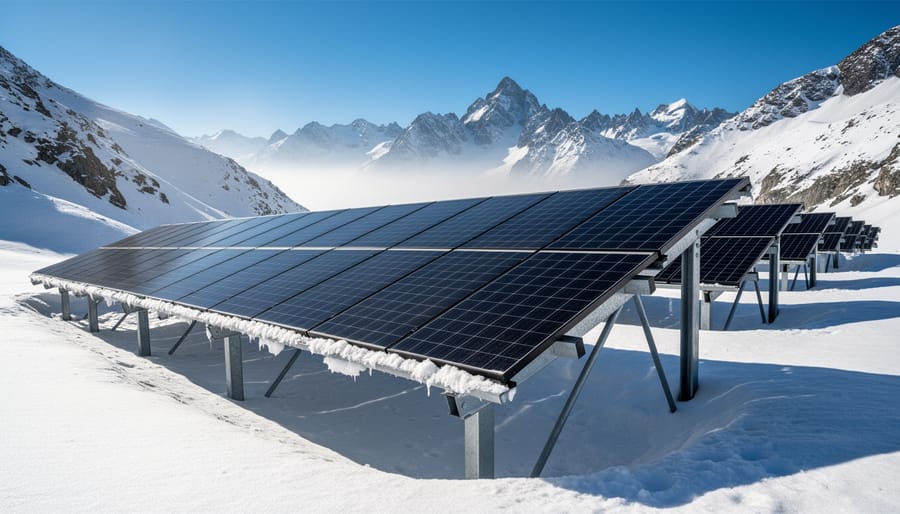
The Pyrenees present a remarkable gradient of climate conditions across a relatively compact geographic area, creating distinct zones for solar optimization. The southern Spanish slopes receive intense Mediterranean sun with over 2,800 hours of annual sunshine, while northern French valleys experience cooler, cloudier Atlantic influences. This variation means installers can deploy different panel configurations matched to local conditions rather than applying generic mountain solutions.
At lower elevations on the Spanish side, high summer temperatures actually reduce panel efficiency, making temperature-coefficient ratings crucial for panel selection. Moving upward and northward, cooler conditions allow panels to operate closer to optimal temperatures year-round, offsetting reduced winter daylight with superior efficiency. The middle elevations often achieve the best balance, combining substantial sun exposure with moderate temperatures that maximize panel performance.
This climatic diversity enables year-round energy production strategies that compensate for seasonal variation. Winter installations at higher elevations benefit from snow reflection and crisp air clarity, while lower Mediterranean-facing slopes maintain strong production during shorter days. Strategic site selection within the Pyrenean corridor allows project designers to match specific client needs with optimal microclimate conditions, whether prioritizing summer peak production or consistent year-round output.
Cross-Border Energy Collaboration
The Pyrenees create a natural laboratory for cross-border solar cooperation that’s transforming how mountain communities approach energy independence. French and Spanish municipalities along the range have established formal knowledge-sharing networks, with quarterly meetings where project managers compare installation performance data across different altitudes and microclimates. This collaboration extends beyond theory, several towns now coordinate their solar deployments to create complementary generation patterns that balance the regional grid.
The mountain geography itself enables innovative storage solutions. Communities on opposite slopes install pumped hydro storage systems that use solar-generated electricity to pump water uphill during peak production hours, then release it through turbines when demand spikes. This natural battery effect works particularly well in the Pyrenees, where existing reservoirs and elevation changes provide ready infrastructure.
What makes this partnership especially effective is the regulatory alignment between France and Spain on renewable energy incentives. Both countries offer similar feed-in tariffs and grid connection standards, eliminating the bureaucratic friction that typically complicates international energy projects. Mountain villages that once struggled with grid stability now export surplus solar generation across borders during summer months, receiving hydroelectric power in winter, a seasonal exchange that maximizes both nations’ renewable resources.
Tourism Infrastructure Meeting Energy Independence
Mountain tourism facilities across the Pyrenees are transforming their energy infrastructure without compromising the visual character that attracts visitors. Ski resorts now integrate solar panels into existing structures, rooftops, lift stations, and equipment buildings, rather than creating conspicuous ground arrays in protected landscapes. France’s Formigal resort powers 40% of its operations through rooftop installations that remain invisible from ski runs, while Spanish facilities near Baqueira-Beret use BIPV (building-integrated photovoltaic) technology on south-facing lodge walls. These installations mirror strategies used in solar neighborhoods where aesthetic integration drives adoption, adapted here for mountain contexts. Hotels and mountain refuges benefit from year-round solar production that peaks during summer hiking seasons, offsetting winter energy costs through net metering agreements. The approach proves that energy independence and landscape preservation aren’t competing priorities but complementary goals when projects prioritize intelligent design over maximum capacity.
The Carpathians: Eastern Europe’s Emerging Solar Frontier
Economic Advantages in Emerging Markets
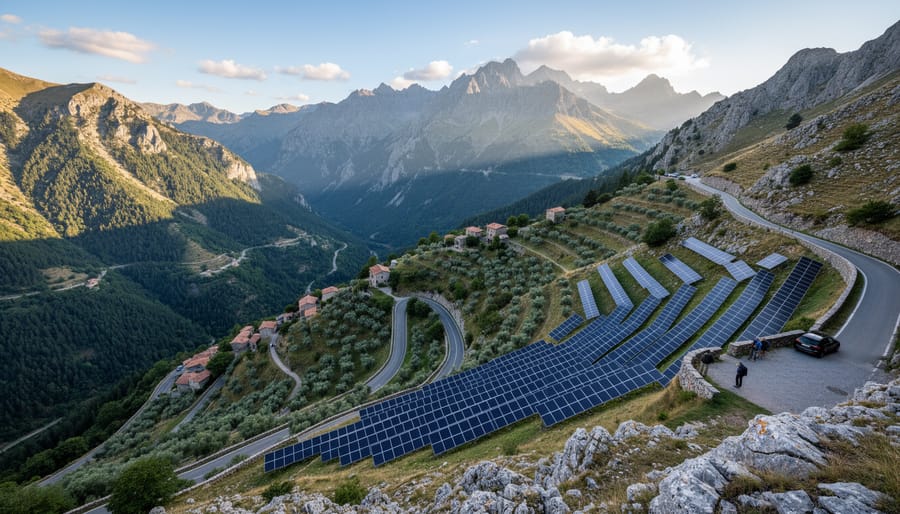
The Carpathian region presents compelling economics that fundamentally change the solar investment equation. Installation costs run 30-40% lower than comparable Alpine projects, driven by competitive labor rates and reduced land acquisition expenses in rural mountain areas. A 10kW residential system that might cost €15,000 in Austria typically ranges €9,000-11,000 across Romanian or Slovakian Carpathian communities.
EU cohesion funds and national renewable energy programs amplify these advantages. Romania’s Casa Verde Photovoltaics scheme covers up to 90% of residential installation costs, while Poland’s My Electricity program offers substantial grants for systems up to 50kW. Slovakia provides feed-in tariffs specifically designed to encourage mountain region deployment.
Commercial applications benefit even more dramatically. A 500kW industrial installation in the Carpathian foothills achieves payback periods of 4-6 years compared to 8-10 years in Western Europe, even accounting for slightly lower electricity prices. Land lease costs remain minimal, and local governments actively court solar developers with tax incentives and streamlined permitting.
This cost structure makes Carpathian solar projects attractive for international investors seeking higher returns while supporting regional economic development and energy transition goals.
Grid Modernization Creating New Opportunities
The Carpathian electrical grid is undergoing its most significant transformation in decades, with Romania, Slovakia, Poland, and Ukraine collectively investing over €4.2 billion in transmission and distribution upgrades between 2023 and 2026. These improvements directly enable solar integration in mountain communities that previously relied on single-line connections vulnerable to weather disruptions. Modern smart grid technology now allows bidirectional energy flow, meaning isolated mountain villages can become net energy producers during peak solar hours while drawing from the grid during low-production periods.
Poland’s southeastern Carpathian region demonstrates this shift clearly: forty-three mountain municipalities gained upgraded substations and digital monitoring systems in 2024 and 2025, reducing grid connection times for new solar installations from eighteen months to under eight weeks. Romania’s national grid operator has prioritized mountain areas for fiber-optic communication infrastructure, enabling real-time monitoring of distributed generation that protects grid stability while accommodating variable solar input.
These upgrades benefit both residential installations and commercial operations. Small manufacturing facilities in Slovak Carpathian towns are now combining grid-connected solar with industrial solar heat systems, using improved grid connections as backup while reducing dependence on imported natural gas. The modernized infrastructure also supports battery storage integration, allowing mountain communities to capture excess production and release it during evening peaks when solar generation drops but local demand remains high.
Rural Electrification Through Mountain Solar
Remote Carpathian villages face a stark reality: unreliable electricity from infrastructure built decades ago. Solar-plus-storage systems are changing this dynamic completely. In Romanian settlements like Rucăr and Polish mountain communities across the Bieszczady range, households now generate 80-90% of their annual electricity needs from rooftop arrays paired with lithium battery banks sized for three-day autonomy.
These systems eliminate the vulnerability of grid outages during winter storms while cutting energy costs by 60-70%. Village cooperatives are pooling resources to install shared battery facilities that stabilize local microgrids, enabling consistent power for medical clinics and schools. The shift matters beyond convenience, it’s catalyzing economic development in regions where young people previously fled due to basic infrastructure failures.
Technical Considerations Across All Three Mountain Ranges
Panel Technology for Mountain Environments
Mountain environments demand solar panels engineered for temperature extremes and mechanical stress that flatland installations never encounter. Monocrystalline panels excel in cold conditions, actually gaining efficiency as temperatures drop below their standard test temperature of 25°C. At typical Alpine altitudes, panels can operate 15-20% more efficiently than rated specifications during winter months.
Bifacial panels represent the next evolution for mountainous terrain. Their dual-sided design captures reflected sunlight from snow-covered surfaces, generating up to 30% additional energy compared to traditional panels in winter conditions. This albedo effect transforms what seems like a seasonal disadvantage into a measurable performance boost.
Durability standards matter more than efficiency ratings alone. Look for panels with reinforced frames rated for snow loads exceeding 5,400 pascals and tested for temperature cycling from -40°C to +85°C. Anti-reflective coatings must withstand UV intensity that increases approximately 10% per 1,000 meters of elevation.
The highest-performing mountain installations combine monocrystalline cell efficiency with bifacial architecture and industrial-grade construction specifications, creating systems that outperform conventional arrays year-round despite harsher operating environments.
Battery Storage in Variable Mountain Climates
Mountain environments demand battery systems engineered for temperature swings that can exceed 60°C between summer peaks and winter lows. Lithium iron phosphate (LiFePO4) batteries outperform standard lithium-ion chemistries in these conditions, maintaining 80% capacity at -20°C compared to 50% for conventional alternatives. Their thermal stability also reduces fire risk in installations where emergency response times are measured in hours rather than minutes.
Seasonal energy patterns drive sizing decisions. Winter consumption typically doubles while production drops by 40-60%, requiring battery capacity of 3-5 days autonomy versus the 1-2 days sufficient for lowland installations. Smart inverters with temperature compensation adjust charging algorithms automatically, preventing damage during cold snaps while maximizing efficiency during summer heat.
Active thermal management extends battery life dramatically. Insulated battery enclosures with heating elements maintain optimal operating temperature (15-25°C) using minimal energy, typically 2-3% of total system output. Some advanced setups harvest waste heat from inverters, creating closed-loop systems that protect batteries without additional energy consumption. Installation inside heated buildings eliminates these concerns entirely, though basement placement requires careful moisture control in mountain climates where snow melt can raise humidity levels.
Project Support for Mountain Installations
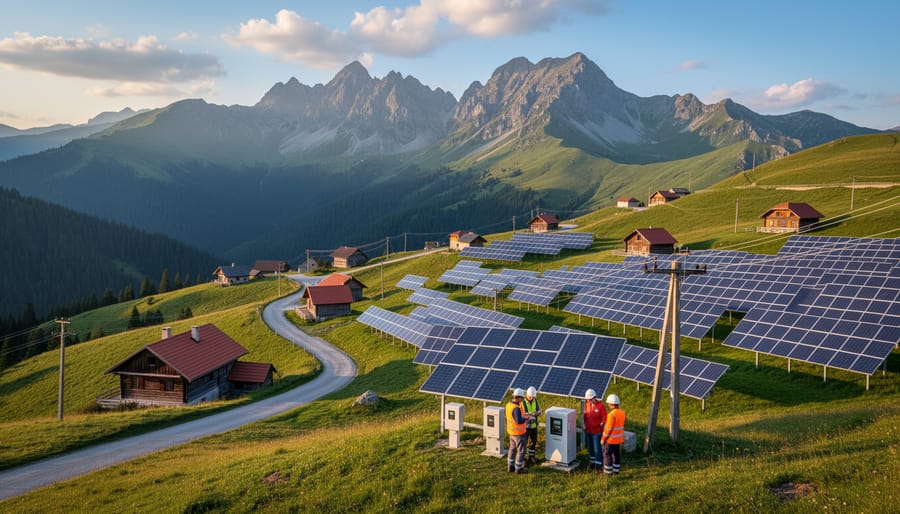
Mountain solar projects demand a fundamentally different approach than conventional installations. Site assessment begins months before any equipment arrives, evaluating not just solar potential but access routes, seasonal weather windows, and local infrastructure capacity. Specialized engineering teams must account for variables that flatland installers never encounter: wind uplift calculations at exposed ridgelines, foundation anchoring in rocky terrain, and equipment transport via cable systems or helicopters when roads don’t reach the site.
The installation phase requires crews trained specifically for mountainous conditions. Standard residential solar teams lack the alpine safety certifications and terrain experience essential for working on steep slopes or at significant elevations. Logistics coordination becomes critical, scheduling concrete pours around weather forecasts, staging materials at intermediate elevation points, and maintaining communication across sites where mobile coverage proves unreliable.
Ongoing maintenance protocols differ substantially from lowland systems. Snow management isn’t optional; it’s essential for high-altitude energy success. Annual inspections must verify mounting integrity after seasonal freeze-thaw cycles, while monitoring systems track performance against altitude-specific baselines. INOX Solar’s integrated project support addresses these complexities from initial feasibility through decades of operation, coordinating specialists who understand that mountain installations aren’t harder versions of standard projects, they’re entirely distinct engineering challenges requiring purpose-built solutions.
Europe’s three major mountain ranges, the Alps, Pyrenees, and Carpathians, are proving that elevation is an advantage, not an obstacle, for solar energy deployment. What once seemed like inhospitable terrain for renewable installations has become a testing ground for innovations that enhance performance across all climates. High-altitude irradiance, reflective snow cover, and increasingly sophisticated engineering solutions have transformed these regions into solar laboratories where technology advances faster than in conventional lowland settings.
The technical progress emerging from mountainous installations ripples outward. Reinforced mounting systems designed for Alpine snow loads perform exceptionally well in coastal wind zones. Battery chemistry optimized for Carpathian temperature swings delivers reliability anywhere seasonal extremes occur. Each successful mountain project expands the envelope of what’s possible for solar energy across Europe.
Beyond technological advancement, these mountain installations strengthen energy independence at both local and continental scales. Remote communities achieve grid autonomy through solar-plus-storage systems, while cross-border networks in the Pyrenees demonstrate how renewable infrastructure can transcend political boundaries. As Europe pursues ambitious decarbonization targets, the lessons learned from challenging mountain terrain become increasingly valuable.
INOX Solar brings comprehensive project support to installations where terrain, climate, and logistics demand specialized expertise. From initial site assessment through commissioning and maintenance, we manage the complexities that make mountain solar projects successful. Whether you’re evaluating feasibility for an Alpine resort, a Pyrenean village, or a Carpathian industrial facility, our integrated approach transforms challenging conditions into reliable energy solutions.
Leave a Reply