Perovskite Solar Cells Are About to Change Everything (Here’s How They’re Made)
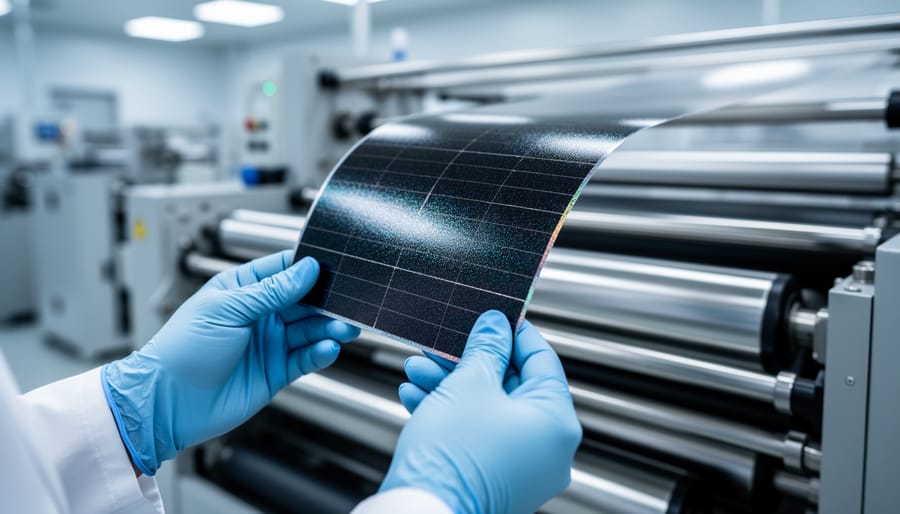
Perovskite solar cells represent the most significant breakthrough in photovoltaic technology in decades, with power conversion efficiencies now exceeding 26% in laboratory settings—rivaling traditional silicon while promising dramatically lower production costs. Yet the critical question facing European manufacturers, installers, and investors isn’t whether this technology works, but how these remarkable cells transition from research benches to factory floors and eventually onto rooftops across the continent.
Manufacturing perovskite solar cells differs fundamentally from conventional silicon production. Where silicon requires energy-intensive processes reaching 1,400°C, perovskite materials form at near room temperature using solution-based coating techniques adapted from printing industries. This manufacturing advantage translates to potential cost reductions of 40-50% compared to silicon, alongside flexibility in application—from rigid panels to lightweight, flexible modules that open entirely new installation possibilities.
European initiatives are positioning the region at the forefront of commercial perovskite production. Companies in Poland, Germany, and the UK are constructing pilot production lines targeting initial commercial rollouts between 2025 and 2027, focusing on tandem architectures that layer perovskite atop silicon to achieve efficiencies beyond 30%. The primary manufacturing challenge remains stability: ensuring panels withstand 25-year operational lifespans despite perovskite’s historical sensitivity to moisture, oxygen, and heat.
Understanding perovskite manufacturing processes—from material deposition methods to encapsulation strategies—reveals both the technology’s transformative potential and the practical timeline before widespread European adoption becomes reality.
What Makes Perovskite Solar Cells Different
The Efficiency Breakthrough
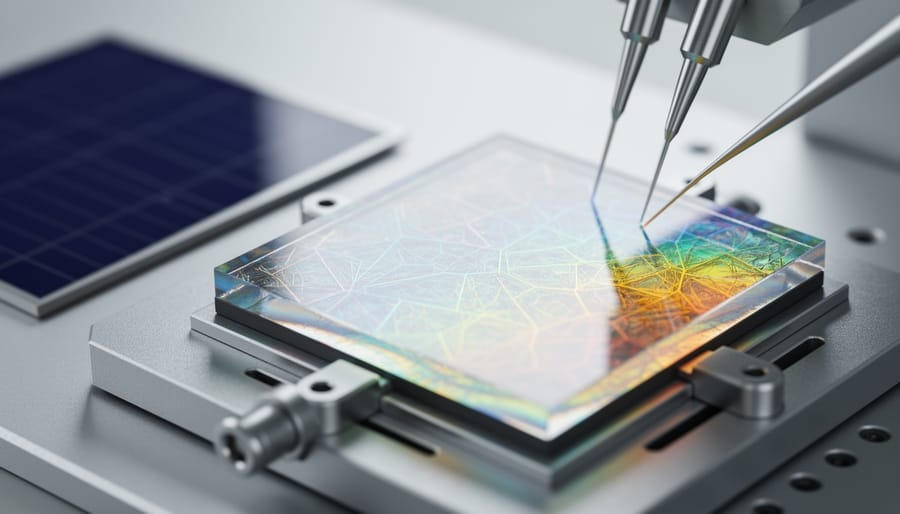
Perovskite solar cells have achieved remarkable efficiency gains in recent years, with laboratory tests consistently recording conversion rates exceeding 26%, approaching the theoretical maximum of 33%. These impressive efficiency breakthroughs position perovskites as serious competitors to traditional silicon panels, which currently achieve around 22-24% efficiency in commercial production. What truly excites researchers and industry professionals is the rapid pace of improvement—perovskite efficiency has jumped from 3.8% in 2009 to today’s levels in just over a decade, a trajectory that took silicon cells nearly 40 years to match.
European research institutions have been instrumental in these advances, with tandem cell configurations combining perovskite and silicon layers reaching efficiencies beyond 33% in laboratory settings. This innovation demonstrates commercial viability, particularly as manufacturing techniques improve to maintain these high performance levels during mass production. For European homeowners and businesses considering solar investments, these efficiency gains translate directly to more power generation from smaller roof areas and faster return on investment.
Material Advantages for European Applications
Perovskite solar cells offer distinct material advantages particularly well-suited to European conditions and applications. Unlike traditional silicon panels that require direct sunlight for optimal performance, perovskites demonstrate exceptional efficiency in diffuse light conditions—a significant benefit given Europe’s frequently cloudy and overcast weather patterns. This characteristic ensures more consistent energy generation throughout the year, especially valuable in northern regions where sunshine hours fluctuate dramatically between seasons.
The inherent flexibility and lightweight nature of perovskite materials open remarkable opportunities for building-integrated photovoltaics across Europe’s diverse architectural landscape. These cells can be manufactured as semi-transparent films for windows, applied to curved surfaces, or integrated into façades without compromising structural integrity—solutions particularly relevant for Europe’s historic buildings where traditional rooftop installations may face regulatory constraints or aesthetic concerns.
Furthermore, perovskite manufacturing processes operate at lower temperatures than silicon production, reducing energy consumption and supporting Europe’s ambitious sustainability targets. The technology’s adaptability enables customized solutions for varied installation scenarios, from residential rooftops to commercial complexes and industrial facilities. As manufacturing scales up across European production sites, these material advantages position perovskite technology as an increasingly practical innovation for achieving the continent’s renewable energy goals while respecting its unique climatic and architectural requirements.
Manufacturing Methods: From Lab to Production
Solution Processing Techniques
One of perovskite solar cells’ most compelling advantages lies in their solution-based manufacturing techniques, which offer remarkable cost efficiency and sustainability compared to traditional silicon production methods. These innovative approaches are transforming how Europe envisions scalable solar manufacturing.
Spin-coating, the most established laboratory technique, involves depositing a liquid perovskite solution onto a substrate that rotates at high speed, spreading the material uniformly through centrifugal force. While excellent for research and achieving high-quality thin films, this method’s material waste makes it less ideal for large-scale commercial production.
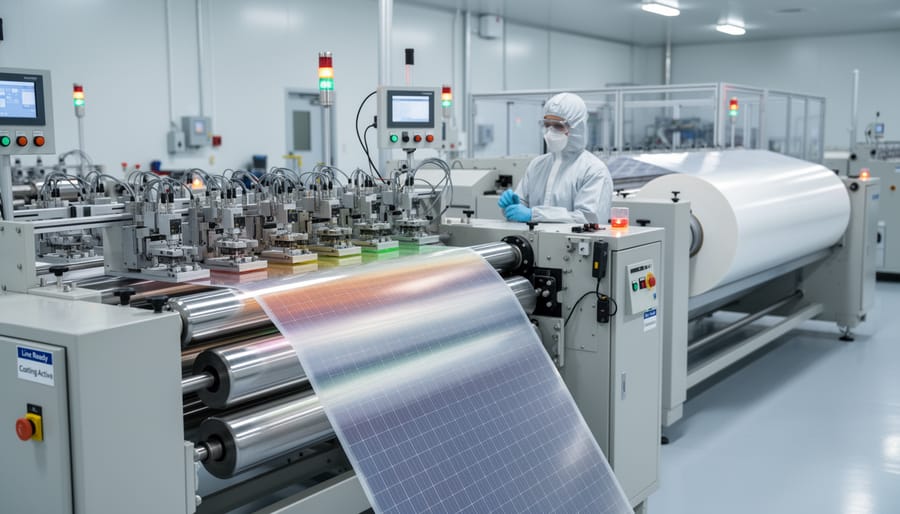
Slot-die coating presents a more manufacturing-friendly alternative. This continuous process precisely deposits perovskite solution through a narrow slot onto moving substrates, much like industrial printing. European manufacturers are particularly interested in this technique because it minimizes material waste, enables roll-to-roll production, and scales effectively to produce solar panels at industrial volumes.
Blade-coating, or doctor blading, offers another scalable solution where a blade spreads perovskite solution across substrates in a controlled manner. This straightforward approach requires minimal equipment investment while maintaining excellent uniformity across large areas.
The sustainability credentials of solution processing are impressive. Unlike silicon solar cell manufacturing, which demands temperatures exceeding 1,400 degrees Celsius, perovskite deposition typically occurs below 150 degrees Celsius. This dramatic reduction in energy requirements translates directly to lower manufacturing costs and smaller carbon footprints—critical considerations for European businesses committed to genuine sustainability. These processing innovations position perovskite technology as both economically viable and environmentally responsible for future solar deployment across Europe.
Vapor Deposition Methods
Vapor deposition methods represent some of the most precise manufacturing approaches for perovskite solar cells, offering exceptional control over layer thickness and material uniformity. These techniques are particularly valuable when creating the multi-layered structures that define high-performance perovskite devices.
Thermal evaporation involves heating perovskite precursor materials in a vacuum chamber until they vaporize, then allowing them to condense onto a substrate in ultra-thin, uniform layers. This method delivers remarkable precision, enabling manufacturers to control layer thickness down to the nanometer scale. The vacuum environment minimizes contamination, contributing to improved cell efficiency and consistency. European research institutions have pioneered innovations in co-evaporation techniques, where multiple materials are deposited simultaneously to create complex perovskite compositions with enhanced stability.
Chemical vapor deposition (CVD) takes a different approach, using chemical reactions between gaseous precursors to form solid perovskite films on heated substrates. CVD excels at producing highly crystalline, defect-free layers that can significantly boost cell performance. The process allows for excellent coverage over large areas and complex surface topographies, making it suitable for tandem solar cell architectures where perovskite layers are combined with traditional silicon cells.
Both methods support the creation of sophisticated multi-layered structures essential for next-generation devices. While vapor deposition techniques currently involve higher equipment costs compared to solution-based methods, their precision benefits make them attractive for premium applications and specialized products. As European manufacturers scale these technologies, we’re seeing promising developments in cost reduction through process optimization and automation, bringing these advanced manufacturing approaches closer to widespread commercial viability.
Quality Control and Stability Challenges
Encapsulation Innovations
The greatest challenge facing perovskite solar cells isn’t efficiency—it’s longevity. These innovative materials are sensitive to moisture, oxygen, and heat, making robust encapsulation absolutely essential for commercial viability.
European researchers are pioneering breakthrough protective barrier technologies that dramatically extend perovskite cell lifespan. Multi-layer encapsulation systems now combine advanced polymers with inorganic moisture barriers, creating hermetic seals that protect sensitive perovskite layers from environmental degradation. These barriers must be flexible yet impermeable, allowing for various installation configurations while maintaining long-term stability.
Moisture-resistant coatings represent another critical innovation. Next-generation hydrophobic materials and atomic layer deposition techniques create ultra-thin protective films just nanometers thick, preventing water ingress without compromising light transmission or adding significant cost.
The European Union’s Horizon Europe programme actively funds collaborative research into encapsulation solutions, with institutions across Germany, Switzerland, and the Netherlands developing standardized testing protocols for accelerated aging studies. These initiatives aim to achieve 25-year warranties comparable to conventional silicon panels—a crucial milestone for market acceptance.
Recent breakthroughs show properly encapsulated perovskite modules maintaining over 95% initial efficiency after 1,000 hours of damp-heat testing, suggesting commercial durability targets are within reach. For homeowners and businesses considering solar investments, these encapsulation advances transform perovskites from laboratory curiosities into genuinely reliable energy solutions.
Testing and Certification Standards
As perovskite solar technology advances toward commercial deployment, establishing robust quality standards becomes essential for market confidence. Unlike traditional silicon panels with decades of field data, perovskite cells require new testing protocols that address their unique material properties and potential degradation pathways.
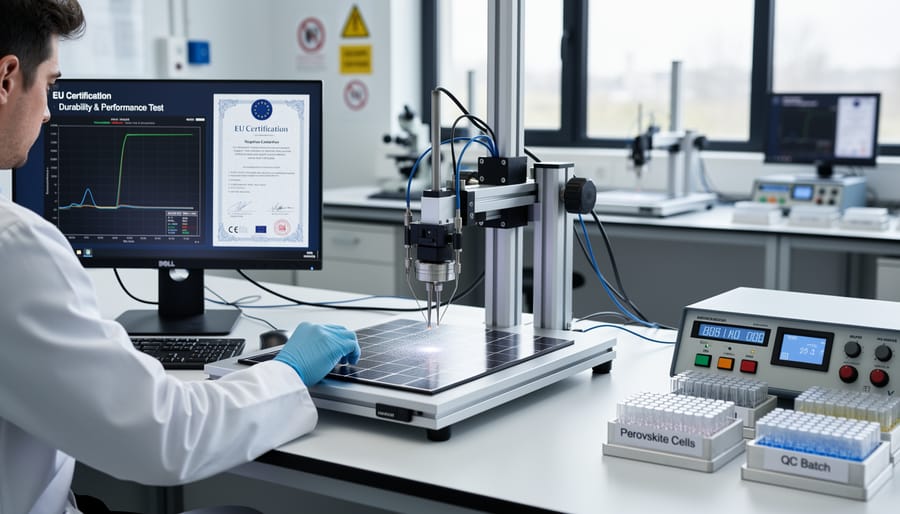
European manufacturers are developing comprehensive testing frameworks that evaluate stability under temperature cycling, humidity exposure, and UV radiation—conditions that historically challenged early perovskite formulations. The International Electrotechnical Commission (IEC) is working alongside European research institutions to adapt existing European certification standards for these next-generation cells, focusing on long-term reliability rather than just initial efficiency.
For residential and commercial installations, manufacturers implement accelerated aging tests that simulate 25+ years of real-world exposure within months. These protocols examine encapsulation effectiveness, electrical performance retention, and resistance to moisture ingress—critical factors for European climates. Third-party verification through accredited testing facilities ensures transparency and builds trust with installers and end-users.
Leading European producers are also establishing internal quality benchmarks that exceed minimum certification requirements, demonstrating commitment to durability and performance. This rigorous approach, combined with standardized testing methodologies, will prove essential as perovskite technology transitions from laboratory innovation to reliable energy solutions for homes and businesses across Europe.
Scaling Up: European Manufacturing Initiatives
Production Facilities and Capacity
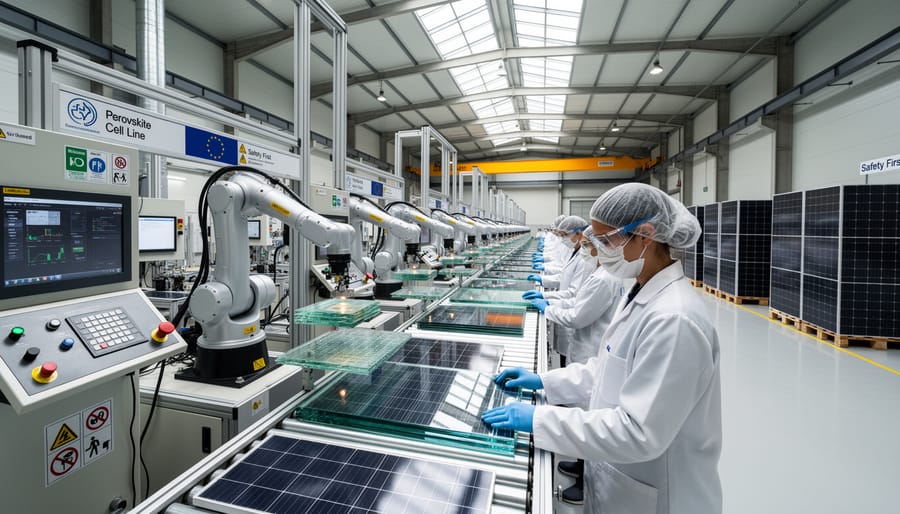
Europe is rapidly positioning itself as a leader in perovskite solar cell manufacturing, with several ambitious projects moving from laboratory to commercial production. Oxford PV in the United Kingdom stands at the forefront, having commissioned a manufacturing facility in Brandenburg, Germany, with initial capacity targeting several hundred megawatts annually. Their tandem perovskite-silicon cells promise efficiency gains that could reshape solar energy economics.
Poland’s Saule Technologies has already begun commercial production, focusing initially on flexible perovskite modules for building-integrated applications. Meanwhile, Swift Solar in the Netherlands and Heliatek in Germany are scaling up production capabilities, targeting niche markets before broader deployment.
Industry analysts project that European perovskite production could reach gigawatt-scale capacity by 2026-2027, though widespread commercial availability for residential and commercial installations will likely emerge gradually between 2025 and 2028. Initial products will probably serve specialized applications before expanding to mainstream solar markets.
These manufacturing initiatives benefit from strong European Union support for clean technology innovation and sustainability, including funding through Horizon Europe programs. The focus remains on establishing reliable, scalable production processes that can compete with established silicon technology while delivering superior efficiency and unique application possibilities for European homes and businesses.
Supply Chain and Material Sourcing
Perovskite solar cells present unique advantages in material sourcing compared to traditional silicon panels. The raw material requirements include lead or tin halides, organic compounds, and relatively common elements, many of which can be sourced within Europe. This reduces dependence on global supply chains and supports regional manufacturing independence.
European suppliers are developing localized networks for perovskite precursor materials, with several chemical manufacturers establishing production facilities to meet anticipated demand. This strategic approach enhances supply security while reducing transportation emissions. Countries like Germany, Italy, and the Netherlands are emerging as key material sourcing hubs, leveraging their established chemical industries.
Sustainability remains central to perovskite supply chain development. Manufacturers are prioritizing low-toxicity formulations, particularly lead-free alternatives using tin-based compounds, to address environmental concerns. Recycling protocols are being integrated from the outset, ensuring end-of-life materials can be recovered and reused efficiently.
The innovation in material sourcing extends to reducing waste during production. Perovskite manufacturing requires significantly less material than silicon processing, with thinner active layers achieving comparable efficiency. This resource efficiency, combined with European sourcing strategies, positions perovskite technology as a sustainable solution for energy transition goals across the continent.
Cost Considerations and Economic Viability
Manufacturing Cost Breakdown
Currently, perovskite solar cells offer a compelling cost advantage over traditional silicon technology. Material costs remain remarkably low—the raw ingredients for perovskite layers cost approximately 90% less than refined silicon. Processing expenses also favor perovskites, as production occurs at temperatures below 150°C compared to silicon’s energy-intensive 1400°C requirements, significantly reducing manufacturing energy consumption.
Initial production costs for perovskite modules hover around €40-50 per square meter at pilot-scale facilities. However, economies of scale promise dramatic improvements as European manufacturers transition to gigawatt-scale production. Industry projections suggest costs could drop to €20-30 per square meter within five years, making solar energy solutions increasingly accessible to homeowners and businesses across Europe.
The innovation extends beyond raw materials—simplified manufacturing processes eliminate expensive vacuum deposition equipment and reduce production steps from over 10 to potentially just 3-4 stages. This streamlined approach means lower capital investment for manufacturing facilities, accelerating the path to widespread commercial availability. As European production capacity expands through sustainability-focused initiatives, these cost efficiencies will translate directly into more affordable, high-efficiency solar installations for residential and industrial applications.
Price Projections for End Users
Current projections suggest perovskite solar panels could initially cost 10-20% less than traditional silicon panels once commercial production scales up between 2026-2028. For European homeowners, this translates to estimated installation costs of €4,500-€6,500 for a typical 5kW residential system, compared to €5,500-€7,500 for conventional panels today. The innovation lies not just in lower manufacturing costs but also in enhanced efficiency, meaning fewer panels are needed to generate the same power output.
Businesses stand to benefit significantly from perovskite technology’s sustainability advantages and space efficiency. A commercial 50kW installation could see 15-25% cost reductions over traditional systems within five years. Long-term savings potential increases further when considering perovskite panels’ superior performance in low-light conditions, particularly relevant for Northern European climates where diffuse light is common.
While early adoption may carry premium pricing, mass production advances in European manufacturing facilities are expected to drive costs below silicon alternatives by 2030, making perovskite technology an increasingly attractive investment for forward-thinking property owners seeking both economic and environmental returns.
Environmental Impact of Perovskite Manufacturing
Perovskite solar cell manufacturing presents a compelling sustainability profile, though several environmental considerations require careful attention as the technology moves toward mass production. The production process itself demonstrates remarkable energy efficiency compared to traditional silicon manufacturing, operating at significantly lower temperatures—typically between 100-150°C rather than the 1400°C required for silicon crystallization. This reduced energy demand translates directly into a smaller carbon footprint during production, aligning well with Europe’s ambitious climate targets.
However, the lead content in many high-performing perovskite formulations remains a legitimate concern under European environmental standards. While the quantity of lead in a typical perovskite solar panel is substantially less than in a conventional car battery, EU regulations like RoHS (Restriction of Hazardous Substances) create stringent compliance requirements. European manufacturers are actively pursuing two parallel approaches: developing lead-free alternatives using tin-based compounds, and implementing robust encapsulation technologies that prevent any potential lead leakage throughout the panel’s lifecycle.
The innovation in sustainable manufacturing extends to material sourcing and waste management. Perovskite precursors are abundant and relatively low-cost, avoiding the supply chain vulnerabilities associated with rare earth elements. European research consortia are pioneering closed-loop manufacturing processes that minimize material waste and solvent emissions, with several facilities achieving near-zero liquid discharge standards.
Recycling initiatives represent another crucial sustainability dimension. Unlike silicon panels requiring energy-intensive thermal processing for material recovery, perovskites can often be dissolved and reconstituted using chemical methods at room temperature. Several European projects are developing economically viable recycling protocols that could recover over 95% of materials, establishing a circular economy framework before widespread commercial deployment.
These environmental considerations aren’t obstacles but rather drivers of innovation, pushing European manufacturers to develop cleaner, more sustainable production methods that meet both regulatory requirements and market expectations for genuinely green energy solutions.
What This Means for European Solar Adoption
The advancement of perovskite solar cell manufacturing presents exciting opportunities for European adoption, though successful integration requires careful consideration of practical factors. For homeowners and businesses currently using traditional silicon panels, the good news is that perovskite technology is designed to complement rather than replace existing infrastructure. Many emerging perovskite products, particularly tandem cells, can integrate with conventional solar installations through standard inverters and mounting systems, minimizing the need for costly overhauls.
Grid compatibility remains a crucial consideration. European electrical grids are well-positioned to accommodate perovskite solar systems, as the technology produces DC electricity that converts through standard inverters just like conventional panels. However, the significantly higher efficiency of perovskite cells means businesses and industries may generate more power from the same roof space, potentially requiring upgraded connection agreements with grid operators. This presents both an opportunity and a planning consideration for commercial adopters.
The successful deployment of perovskite technology across Europe will depend on comprehensive support systems. Installation professionals will need training on handling these advanced materials, particularly during the transition period when manufacturing techniques and product specifications continue evolving. Quality assurance protocols must adapt to verify the longevity claims manufacturers are making, ensuring European consumers receive products that deliver on their 25-year performance promises.
For forward-thinking businesses and industries, perovskite manufacturing advancements signal an opportunity to future-proof energy strategies. The technology’s flexibility enables applications beyond traditional rooftop installations, including building-integrated photovoltaics and specialized industrial settings. As European manufacturing facilities scale up production, local supply chains will strengthen, reducing dependency on imports while supporting the continent’s sustainability goals. The key for potential adopters is staying informed, working with experienced solar partners who understand both current capabilities and emerging innovations, and planning installations that can accommodate evolving technology standards.
Perovskite solar cell manufacturing stands at an exciting threshold between laboratory innovation and commercial reality. While these advanced cells demonstrate remarkable efficiency gains and sustainability potential, the path to widespread availability requires continued refinement of production processes, durability improvements, and regulatory approvals. European manufacturers and research institutions are making significant progress, with pilot production lines already operational and targeted commercial launches expected within the next three to five years for specialized applications, followed by broader market availability as the technology matures.
For European homeowners, businesses, and industries planning solar investments, this timeline suggests a thoughtful approach: current silicon-based systems remain excellent long-term investments, while keeping informed about emerging solar technologies ensures you’re positioned to benefit from future advancements. Perovskite technology may eventually offer tandem configurations or specialized applications that complement existing installations.
INOX Solar remains committed to monitoring these manufacturing developments closely, evaluating technologies rigorously, and integrating proven innovations that deliver genuine value to our clients. Our comprehensive project support means we’ll guide you through technological transitions as they become commercially viable, ensuring your solar energy strategy adapts to the evolving landscape without compromising reliability or performance.
Stay engaged with industry developments, ask questions about how new technologies might benefit your specific situation, and trust that genuine innovation will be supported by manufacturers committed to quality and long-term partnerships throughout Europe’s renewable energy transformation.
Leave a Reply