Why Hydrogen Storage Could Solve Europe’s Biggest Energy Challenge
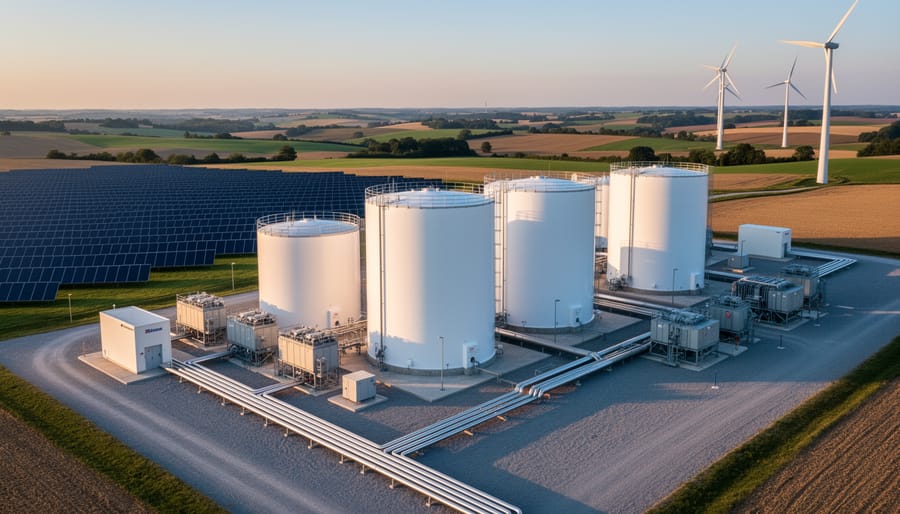
The renewable energy revolution faces a critical bottleneck: wind and solar generate power when nature dictates, not when consumers need it. Grid-scale energy storage has emerged as the essential bridge between intermittent renewable generation and consistent energy demand, enabling Europe to transform its climate ambitions into operational reality.
Unlike household batteries that power individual homes for hours, grid-scale storage operates at an entirely different magnitude. These systems absorb gigawatt-hours of excess renewable electricity during peak production periods and discharge it during demand surges or generation lulls. The technology encompasses multiple approaches, from lithium-ion battery arrays spanning football fields to underground hydrogen facilities storing energy for weeks or months.
Europe’s energy transition depends fundamentally on solving this storage challenge. Countries like Germany and Spain already experience moments when solar and wind generate more electricity than the grid can handle, forcing operators to curtail production or export power at negative prices. Simultaneously, calm winter evenings create supply gaps that currently require fossil fuel backup. Grid-scale storage eliminates this paradox, capturing surplus renewable energy and releasing it precisely when needed.
Hydrogen storage represents the most promising solution for long-duration, seasonal storage requirements that batteries cannot economically address. While battery systems excel at smoothing daily fluctuations, hydrogen facilities can store summer’s abundant solar energy for winter heating demands. This complementary relationship between storage technologies creates resilient energy infrastructure capable of operating entirely on renewables.
For businesses and industries evaluating energy strategies, understanding grid-scale storage options determines competitiveness in an increasingly decarbonized economy. The following examination explores how hydrogen storage functions within this ecosystem, its current European deployment, economic considerations, and practical integration alongside established technologies.
Understanding Grid-Scale Energy Storage: The Foundation of Renewable Energy
The Intermittency Problem Europe Faces
Europe’s transition to renewable energy has revealed a fundamental challenge: the sun doesn’t always shine when we need power, and wind patterns rarely align with peak demand. Unlike traditional power plants that generate electricity on demand, solar and wind facilities produce energy according to nature’s schedule, creating substantial intermittency issues for grid operators across the continent.
During summer months, solar panels generate abundant electricity, yet heating demand remains low. Conversely, winter brings peak energy consumption precisely when solar output diminishes and cloud cover increases. This seasonal energy mismatch affects countries from Spain to Sweden, creating periods of significant surplus followed by critical shortages.
The variability extends beyond seasons. Daily fluctuations pose immediate challenges—morning solar ramps coincide with breakfast demand, yet evening peaks occur after sunset. Wind patterns prove equally unpredictable, with high-pressure systems sometimes reducing output across entire regions for days.
Grid-scale energy storage emerges as the essential solution to bridge these temporal gaps. Traditional battery systems excel at managing daily cycles, storing excess afternoon solar for evening use. However, Europe’s renewable ambitions require something more substantial: long-duration storage capable of shifting energy across weeks or months.
This is where hydrogen technology demonstrates particular promise. By converting surplus renewable electricity into hydrogen during abundance and regenerating power during scarcity, hydrogen storage offers seasonal balancing capabilities that complement battery systems. The innovation lies in creating integrated storage solutions that match Europe’s diverse climate patterns and consumption profiles, ensuring grid stability while maximizing renewable energy utilization throughout the year.
Current Storage Technologies and Their Limitations
Today’s grid relies primarily on several established energy storage technologies, each with distinct advantages and limitations that shape their deployment across Europe.
Lithium-ion batteries have become the leading choice for short-duration storage, particularly for smoothing solar and wind fluctuations over hours. Their rapid response times and declining costs have driven impressive growth in installations from Germany to Spain. However, these systems face constraints in longer-duration applications—typically economical only for 2-4 hours of discharge—and rely on materials with supply chain vulnerabilities and recycling challenges that European industries are actively addressing.
Pumped hydro storage remains the most proven large-scale solution, accounting for over 90% of global grid storage capacity. By pumping water uphill during energy surplus and releasing it through turbines when needed, these facilities can store enormous amounts of energy for days or weeks. Yet their geographic requirements—specific topography with elevation differences and water availability—severely limit expansion potential, particularly in densely populated regions where suitable sites are already developed.
Compressed air energy storage and flow batteries offer promising alternatives but remain limited in commercial deployment. Thermal storage shows potential for industrial applications, though integration with existing infrastructure requires careful planning.
These established technologies excel within their design parameters but cannot fully address the seasonal storage challenge facing renewable-heavy grids—a gap where emerging solutions like hydrogen are generating considerable innovation and interest across the European energy sector.
Hydrogen Storage for Grid-Scale Applications: How It Works
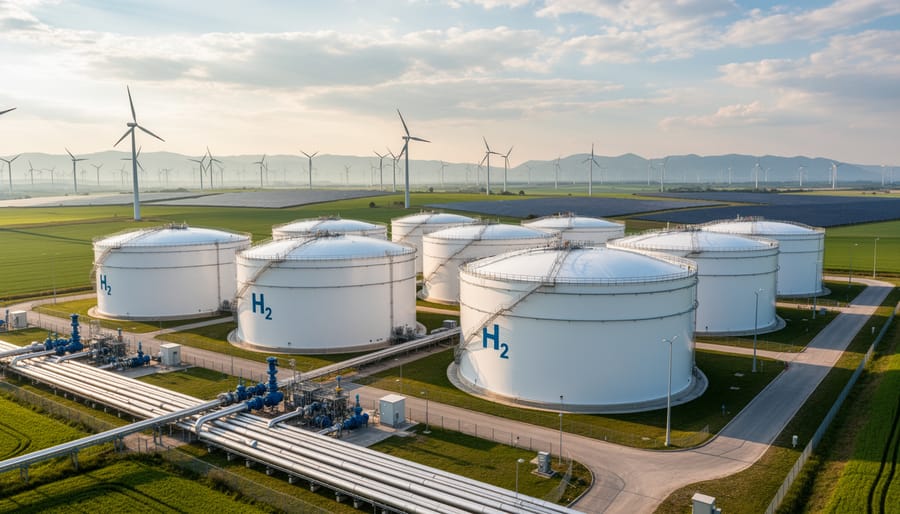
The Power-to-Hydrogen-to-Power Cycle
The power-to-hydrogen-to-power cycle represents a sophisticated approach to energy storage that transforms excess renewable electricity into a chemical fuel and back again when needed. This conversion process begins when surplus solar or wind power drives electrolyzers, which split water molecules into hydrogen and oxygen through electrolysis. The hydrogen is then compressed, stored in specialized tanks or underground caverns, and later reconverted to electricity through fuel cells or hydrogen-ready turbines during periods of high demand.
Understanding the efficiency considerations is essential for realistic expectations. The complete cycle typically achieves round-trip efficiency of 30-50%, meaning considerable energy is lost during conversion and storage. While this seems modest compared to lithium-ion batteries achieving 85-95% efficiency, the comparison misses the fundamental point: hydrogen excels precisely where batteries struggle.
What makes hydrogen unique for long-duration storage is its ability to store vast quantities of energy across seasons without degradation. Unlike batteries that lose charge over time and face capacity limitations, hydrogen can be stored for months, making it invaluable for addressing Europe’s seasonal renewable energy mismatch. During summer months when solar production peaks, excess electricity converts to hydrogen. Come winter, when heating demand soars and solar output drops, that stored hydrogen provides reliable backup power.
This innovation proves particularly relevant for industries and businesses requiring multi-day or seasonal storage rather than the few hours batteries provide. The sustainability advantage lies in utilizing existing infrastructure—repurposed natural gas caverns across Europe already store hydrogen at scale. For comprehensive energy solutions combining immediate battery storage with long-term hydrogen reserves, this dual approach ensures grid stability while maximizing renewable integration throughout the year.
Storage Methods: From Compressed Gas to Liquid Hydrogen
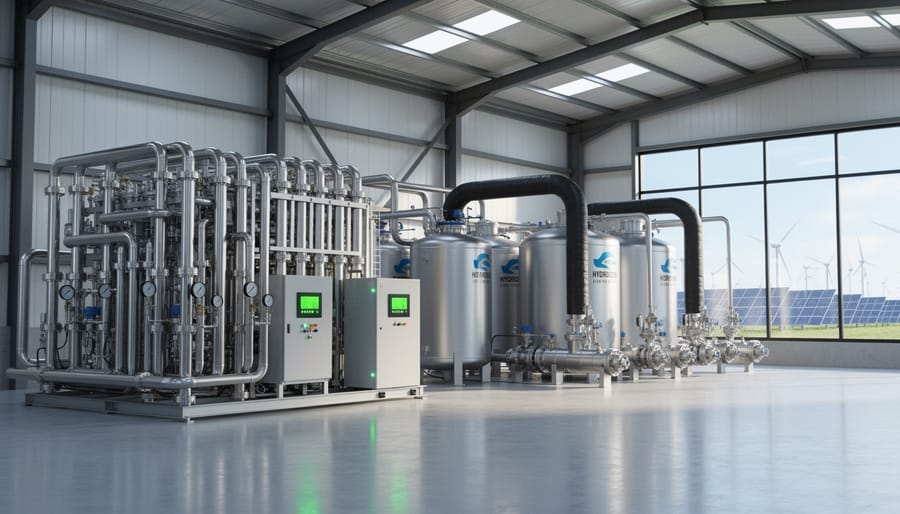
Storing hydrogen for grid-scale applications presents unique engineering challenges that directly impact system efficiency and economic viability. The storage method you choose determines not only capital costs but also the energy balance of your entire hydrogen infrastructure.
Compressed gas storage represents the most established approach, typically operating at pressures between 350 and 700 bar. While relatively straightforward to implement, compression itself consumes approximately 10-15% of the stored energy. This method suits medium-scale installations and shorter storage durations, making it popular for initial hydrogen projects across Europe.
Liquid hydrogen storage offers impressive energy density but requires cryogenic temperatures of -253°C. The liquefaction process is energy-intensive, consuming roughly 30% of the hydrogen’s energy content. Despite this drawback, liquid storage becomes economically attractive for very large volumes or when space constraints are paramount.
Underground cavern storage presents perhaps the most promising solution for true grid-scale applications. Salt caverns, depleted gas fields, and aquifers can store massive quantities of hydrogen with minimal energy loss. Several European countries, particularly Germany and the Netherlands, are actively developing these geological storage sites, leveraging existing natural gas infrastructure. This approach offers seasonal storage capacity essential for balancing renewable energy fluctuations throughout the year.
Materials-based storage, including metal hydrides and chemical carriers, remains largely experimental for grid applications but shows innovation potential. These technologies could eventually offer safer, more compact storage solutions, though current costs and efficiency levels require further development before widespread deployment becomes practical.
Why Hydrogen Storage Makes Sense for European Energy Systems
Bridging Summer Solar Abundance to Winter Demand
Europe faces a fundamental energy mismatch: solar panels generate abundant electricity during long summer days precisely when heating demand is lowest, while winter months bring peak energy consumption with minimal solar output. Batteries excel at storing energy for hours or days, but storing summer’s solar abundance for winter use would require prohibitively expensive battery installations covering vast areas.
This is where hydrogen storage demonstrates its unique capability. During summer months, excess solar electricity can power electrolyzers that split water into hydrogen and oxygen. This hydrogen stores energy chemically at remarkable density—one kilogram contains roughly the same energy as three kilograms of gasoline. Unlike batteries that gradually lose charge, properly stored hydrogen can sit for months without degradation, making seasonal energy shifting economically viable.
Large-scale hydrogen storage facilities across Europe are proving this concept. Underground caverns, repurposed natural gas storage sites, and purpose-built tanks can hold enough hydrogen to power communities through winter when solar production plummets. When needed, fuel cells or hydrogen-compatible turbines convert this stored energy back to electricity, providing reliable grid stability solutions during dark winter months.
This seasonal storage capability complements shorter-term battery systems perfectly, creating a comprehensive energy ecosystem where each technology addresses specific temporal needs—batteries managing daily fluctuations while hydrogen bridges seasonal gaps.
Infrastructure Synergies: Repurposing Natural Gas Networks
Europe’s extensive natural gas network represents a remarkable opportunity to accelerate hydrogen deployment while controlling infrastructure costs. The continent possesses over 200,000 kilometers of gas pipelines, much of which can be repurposed for hydrogen transport with strategic modifications. This existing asset dramatically reduces the capital requirements compared to building entirely new distribution systems.
The compatibility between natural gas infrastructure and hydrogen varies by component. Modern high-pressure transmission pipelines often require minimal adaptation, primarily involving upgraded seals and monitoring equipment to accommodate hydrogen’s smaller molecular size. Distribution networks serving homes and businesses may need more extensive retrofitting, though many newer installations already meet compatibility standards.
Germany’s THyGA project demonstrates this potential, successfully testing hydrogen blends up to 20 percent in existing residential gas networks. The Netherlands has designated specific regions for complete conversion to pure hydrogen, leveraging decades-old pipeline infrastructure. These initiatives prove that repurposing can happen incrementally, allowing continued service while transitioning to cleaner energy carriers.
Underground storage facilities present particularly compelling opportunities. Salt caverns, depleted gas fields, and aquifers currently storing natural gas can accommodate hydrogen with engineering adjustments. Europe’s existing storage capacity exceeds 1,000 TWh, offering massive seasonal energy storage potential crucial for balancing renewable generation fluctuations.
This infrastructure synergy significantly improves hydrogen’s economic case. Rather than viewing gas networks as stranded assets, strategic repurposing transforms them into enablers of sustainable energy systems, reducing implementation timelines and costs while maintaining energy security throughout Europe’s transition.
Real-World Applications and European Projects Leading the Way
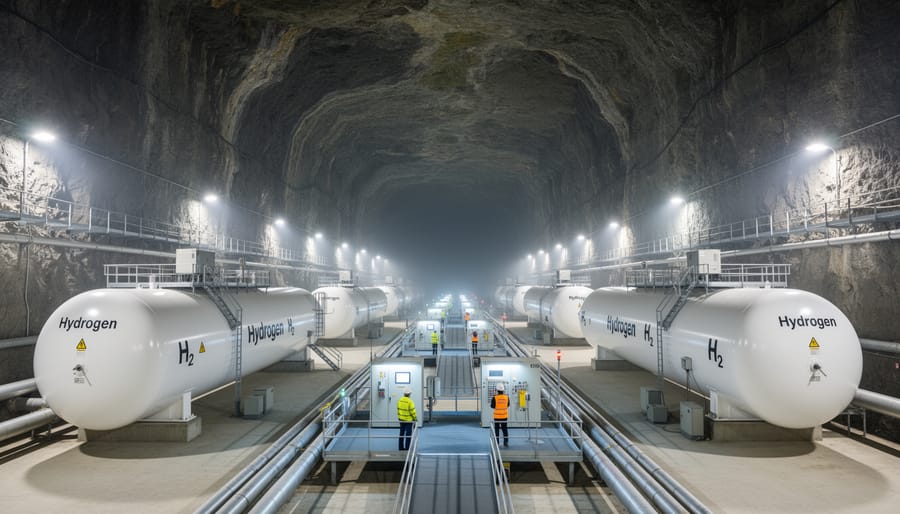
Commercial-Scale Installations Transforming Energy Grids
Europe is leading the charge in deploying commercial-scale hydrogen storage facilities that demonstrate real-world viability for grid integration. Germany’s HyGreen project in Kempten operates a 2.4 MW electrolyzer connected to renewable sources, storing excess energy as hydrogen with round-trip efficiency approaching 38-42%. The facility has successfully supplied industrial customers while providing grid balancing services since 2019.
In the Netherlands, the HyStock initiative at Gasunie’s Veendam facility represents one of Europe’s first large-scale hydrogen storage caverns, capable of storing 3.6 million cubic meters of hydrogen underground. This project showcases how existing natural gas infrastructure can be repurposed for the clean energy transition, contributing significantly to European energy independence.
Denmark’s HySynergy project in Copenhagen integrates 1.25 MW of electrolyzer capacity with local wind farms, converting surplus electricity into hydrogen for transport and industrial applications. Performance data indicates approximately 70% electrical efficiency during hydrogen production, with storage providing seasonal flexibility that battery systems cannot match.
Austria’s Underground Sun Storage 2030 demonstrates innovation in porous rock hydrogen storage, targeting 1.2 TWh capacity by 2030. These operational facilities collectively prove that hydrogen storage technology has moved beyond pilot phases, offering practical solutions for managing renewable energy variability across multiple timeframes. While costs remain higher than battery storage for short-duration applications, these installations validate hydrogen’s unique role in long-duration, seasonal energy management essential for comprehensive grid decarbonization strategies.
The Economics: Costs, Efficiency, and Long-Term Viability
Understanding Round-Trip Efficiency
Let’s be transparent about efficiency: hydrogen storage operates at approximately 35-45% round-trip efficiency, meaning significant energy losses occur during conversion, storage, and reconversion. This contrasts sharply with lithium-ion battery systems, which typically achieve 85-95% efficiency. While this might seem like a considerable disadvantage, context matters enormously for grid-scale applications.
The critical distinction lies in duration. Battery efficiency excels for short-term storage spanning hours to a few days, making them ideal partners for solar installations. However, hydrogen’s lower efficiency becomes acceptable—even advantageous—when storing renewable energy for weeks or months. For seasonal storage across European winters when solar generation diminishes, losing 55-65% of energy during the hydrogen cycle often proves more economical than maintaining massive battery banks that would sit largely idle.
The innovation in hydrogen storage addresses a fundamentally different challenge: bridging renewable generation gaps that batteries cannot economically serve. When evaluating sustainability at grid scale, the ability to store surplus summer solar energy for winter demand often outweighs conversion losses, particularly as electrolyser efficiency continues improving and renewable capacity expands across Europe.
Challenges and Considerations for Widespread Adoption
While hydrogen storage presents compelling possibilities for grid-scale energy storage, several substantive challenges must be addressed before widespread adoption becomes reality across Europe. Understanding these obstacles is essential for businesses and industries evaluating long-term energy strategies.
Technology maturation remains a primary consideration. Current electrolysis systems, particularly those using renewable electricity, require further efficiency improvements to achieve cost-competitiveness with conventional energy storage methods. The round-trip efficiency of hydrogen storage—from electricity to hydrogen and back to electricity—typically ranges between 30-50%, notably lower than battery storage systems. However, ongoing innovation in electrolyzer technology and fuel cell development shows promising advancement trajectories.
Infrastructure requirements present considerable implementation barriers. Hydrogen storage demands specialized equipment including high-pressure tanks, pipelines resistant to hydrogen embrittlement, and dedicated safety systems. Many European nations lack the necessary infrastructure network, requiring substantial capital investment before hydrogen can integrate seamlessly with existing energy grids. This contrasts with solar energy systems, which can deploy more rapidly with established supply chains and installation expertise.
Safety considerations warrant careful attention, though they shouldn’t be overstated. Hydrogen’s flammability requires rigorous handling protocols, comprehensive staff training, and robust regulatory compliance. European safety frameworks continue evolving to address hydrogen-specific risks while enabling responsible deployment.
Regulatory frameworks across Europe remain fragmented, with varying standards between nations creating complexity for cross-border projects. Harmonized regulations would significantly accelerate adoption and reduce compliance costs for businesses operating in multiple markets.
Economic viability currently depends heavily on project scale and application. While hydrogen storage excels for seasonal energy shifting and long-duration storage, the initial capital expenditure remains substantial. Government subsidies and supportive policies play crucial roles in bridging the economic gap during this transitional period.
Despite these challenges, the sustainability benefits and potential for renewable energy integration continue driving European investment in hydrogen storage solutions, positioning it as a valuable component within comprehensive energy strategies.
How Hydrogen Storage Complements Solar and Battery Systems
Rather than competing technologies, hydrogen storage, batteries, and solar power form complementary layers in modern energy infrastructure. Each technology excels at different timescales and applications, creating integrated renewable systems that address the full spectrum of energy storage needs.
Batteries provide the immediate response capability essential for grid stability, handling short-term fluctuations and daily cycles efficiently. They excel at capturing solar energy during peak production hours and releasing it during evening demand spikes. However, their economics become less favorable for extended storage periods beyond several hours.
This is where hydrogen storage adds tremendous value. While batteries manage hourly to daily cycles, hydrogen systems excel at seasonal storage—capturing abundant summer solar production for use during winter months when European solar output drops significantly. This capability is particularly valuable for balancing renewable generation across quarters rather than just days.
The synergy becomes evident in comprehensive energy projects. Solar installations generate clean electricity, batteries smooth out immediate variations and optimize self-consumption, while hydrogen systems store surplus energy that would otherwise be curtailed during high-production periods. During prolonged cloudy periods or seasonal lows, hydrogen can fuel stationary fuel cells or combustion systems to maintain supply.
European facilities are increasingly adopting this multi-layer approach. Industrial sites combine rooftop solar with battery systems for daily operations and hydrogen storage for backup power and seasonal balancing. This integration maximizes renewable utilization rates while maintaining reliability—the batteries handle 80-90% of daily cycling needs efficiently, while hydrogen captures the remaining seasonal surplus that would otherwise go unused.
The result is a resilient, flexible energy ecosystem where each technology reinforces the others, delivering both sustainability and energy independence.
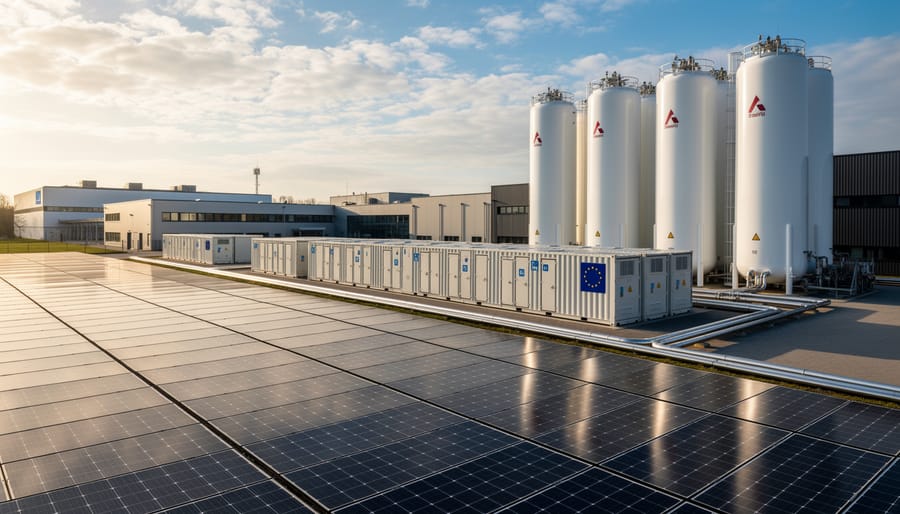
Hydrogen storage stands at the intersection of innovation and sustainability, offering European businesses and industries a compelling pathway toward energy independence and climate neutrality. While the technology continues to mature, its potential to bridge seasonal energy gaps and provide long-duration storage capabilities positions it as a vital component within integrated renewable energy systems. The European commitment to hydrogen infrastructure development signals confidence in this technology’s role in achieving ambitious carbon reduction targets.
For organizations planning their energy future, hydrogen storage should be viewed not in isolation but as part of a comprehensive ecosystem that includes solar generation, battery storage, and smart grid integration. The economics will continue improving as electrolyzer costs decline, renewable electricity becomes more abundant, and regulatory frameworks solidify. Early adopters positioning themselves within emerging hydrogen value chains may find significant competitive advantages as markets mature.
The transition to renewable energy demands forward-thinking approaches that embrace multiple technologies working in concert. European businesses investing in solar installations today are laying groundwork for tomorrow’s hydrogen-integrated systems. This progression from immediate battery storage solutions to seasonal hydrogen backup represents a logical evolution rather than a disruptive replacement.
Success requires partnering with experienced providers who understand both current technologies and future possibilities, offering comprehensive support throughout your energy transition journey. Europe’s energy independence depends on this strategic combination of proven solar technology, advancing storage solutions, and the innovation mindset necessary to embrace hydrogen’s emerging role in our sustainable energy future.
Leave a Reply