Solar-Powered Trains Transform European Rail: The Future Is Already Here
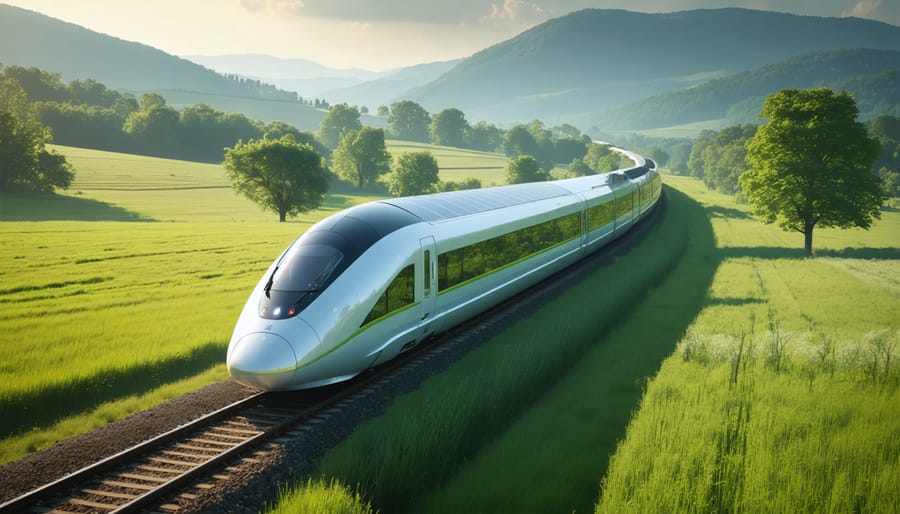
Solar-powered trains are revolutionizing rail transport across Europe, marking a decisive shift toward sustainable mass transit solutions. As railways tap into Europe’s solar potential, these innovative systems combine photovoltaic technology with existing rail infrastructure to create zero-emission transportation networks.
Beyond the traditional overhead electrical systems, modern solar trains utilize a sophisticated combination of trackside solar panels, energy storage systems, and smart grid integration. This breakthrough technology already powers portions of rail networks in countries like Italy, Belgium, and the Netherlands, demonstrating the viable fusion of renewable energy with high-speed rail transport.
The integration of solar power into railway systems represents more than an environmental victory – it’s a strategic solution to rising energy costs and grid dependency. With trains consuming nearly 1.7% of the European Union’s total electricity demand, solar-powered railways offer a compelling path toward energy independence and sustainable mobility. These systems not only reduce operational costs by up to 30% but also ensure consistent power supply through innovative energy storage solutions, marking a transformative moment in railway engineering.
The Technology Behind Solar-Powered Trains
Solar Panel Integration Systems
Solar panel integration systems for railway applications employ specialized photovoltaic panels designed to withstand the unique challenges of rail environments. These panels feature enhanced durability to resist vibrations, weather extremes, and electromagnetic interference from passing trains. The integration typically follows two main approaches: direct installation on railway infrastructure and trackside solar farms.
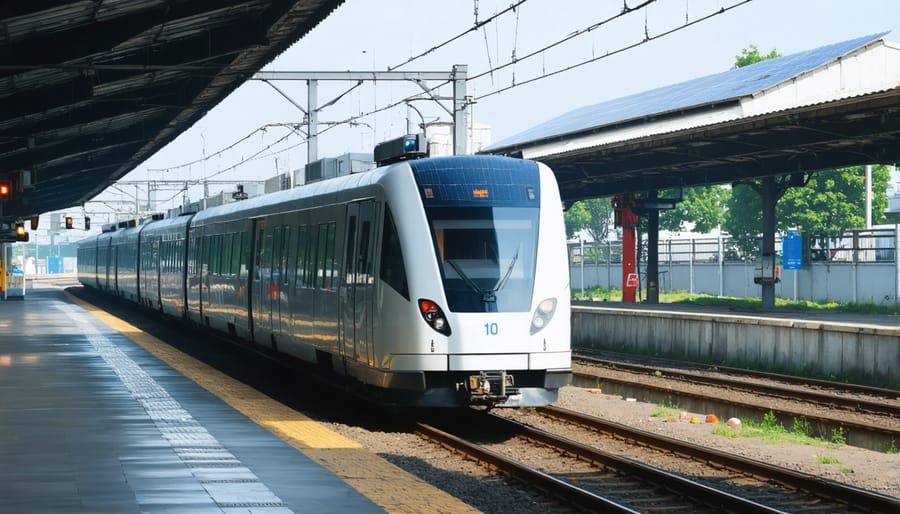
Along rail corridors, panels are strategically mounted on noise barriers, platform roofs, and station buildings, maximizing otherwise unused space. Modern mounting systems incorporate anti-glare technology to prevent sun reflection from interfering with train operations and driver visibility. The panels are typically arranged in series to optimize power generation while maintaining the structural integrity of existing railway infrastructure.
Advanced monitoring systems ensure optimal performance and swift maintenance response. Smart sensors continuously track energy production, panel temperature, and system health, transmitting real-time data to control centers. This enables predictive maintenance and efficient power distribution across the rail network.
The installation process requires careful planning to minimize service disruption. Engineers conduct detailed site surveys to assess sunlight exposure, structural capabilities, and grid connection points. Installation teams work during off-peak hours, using specialized equipment designed for rapid deployment while maintaining strict safety standards.
These systems often incorporate energy storage solutions to ensure consistent power supply during periods of low solar generation, creating a reliable and sustainable power source for railway operations.

Energy Storage Solutions
Energy storage systems play a crucial role in making solar-powered trains a viable transportation solution. Modern lithium-ion battery systems, strategically positioned along railway routes, store excess solar energy generated during peak sunlight hours for use during cloudy periods or nighttime operations.
These advanced storage solutions typically combine high-capacity batteries with sophisticated energy management systems that optimize power distribution. The batteries are housed in climate-controlled containers at key points along the railway network, ensuring reliable power supply throughout the journey.
Recent innovations in energy storage technology have led to the development of regenerative braking systems, which capture and store kinetic energy produced when trains decelerate. This recovered energy can then be redistributed to power other trains or stored for later use, significantly improving the overall system efficiency.
European rail networks are increasingly adopting smart grid integration techniques that allow for dynamic energy management. These systems continuously monitor power demand, storage levels, and solar generation, automatically adjusting power distribution to maintain optimal performance. Some installations feature hybrid solutions that combine different storage technologies, such as lithium-ion batteries with supercapacitors, to handle both long-term energy storage and rapid power delivery needs.
The integration of these storage solutions has proven particularly effective in regions with variable weather conditions, ensuring consistent train operations regardless of solar conditions.
Current European Implementation Projects
Success Stories and Case Studies
Several groundbreaking solar-powered train projects across Europe demonstrate the viability of this sustainable transportation technology. In Byron Bay, Australia, the world’s first fully solar-powered train began operation in 2017, setting a precedent for similar urban mobility solutions in Europe.
The Kismaros-Királyrét railway line in Hungary showcases successful integration of solar power, where photovoltaic panels along the track provide up to 25% of the train’s energy requirements. This implementation has reduced operational costs by approximately 30% while significantly decreasing carbon emissions.
In the Netherlands, the Dutch railway network achieved a milestone in 2017 when all electric trains began running on 100% wind energy, complemented by solar installations at major stations. The Utrecht Central Station’s solar roof installation generates enough power to support daily operations and contribute to the grid.
The Indian Railways’ ambitious solar project in Delhi demonstrates large-scale feasibility, with solar panels installed on station rooftops generating 2 megawatts of power daily. This success has inspired similar implementations across European railway stations, particularly in Germany and Spain.
The Brighton & Hove Bus Company in the UK successfully integrated solar panels at their depot, powering both their electric buses and auxiliary systems. This hybrid approach to renewable energy in transport infrastructure has become a model for integrated solar solutions in railway operations.
These case studies highlight the practical application of solar power in rail transport, proving that sustainable railway operations are not just theoretical but achievable and economically viable.
Infrastructure Adaptations
Implementing solar-powered trains requires significant adaptations to existing railway infrastructure, with modifications needed across multiple system components. The most visible change involves the installation of solar panels along railway tracks, either mounted on specially designed canopies or integrated into noise barriers. These installations must be carefully positioned to maximize sunlight exposure while maintaining safe clearances for trains and maintenance equipment.
Power distribution systems require substantial upgrades to handle the intermittent nature of solar energy. This includes the installation of smart transformers and advanced energy storage facilities at strategic points along the route. Modern rail networks need sophisticated power management systems to efficiently distribute solar-generated electricity and seamlessly switch between solar and conventional power sources when necessary.
Track electrification infrastructure must be modified to accommodate bi-directional power flow, allowing excess solar energy to be fed back into the grid. This involves upgrading existing overhead lines or third rails with enhanced conductivity materials and installing new monitoring equipment to ensure stable power delivery.
Stations and maintenance facilities also require retrofitting with solar-compatible charging systems and energy management interfaces. This includes the installation of energy storage solutions, such as advanced battery systems or hydrogen fuel cells, to maintain consistent power supply during periods of low solar generation.
Safety systems need enhancement to monitor and respond to variations in power supply. This encompasses upgraded signaling equipment, automated power distribution controls, and emergency backup systems. Additionally, weather monitoring stations must be integrated along the route to predict solar generation capacity and optimize train scheduling accordingly.
These infrastructure adaptations, while substantial, represent a crucial investment in sustainable rail transport, positioning European railways at the forefront of renewable energy innovation.
Environmental and Economic Benefits
Carbon Footprint Reduction
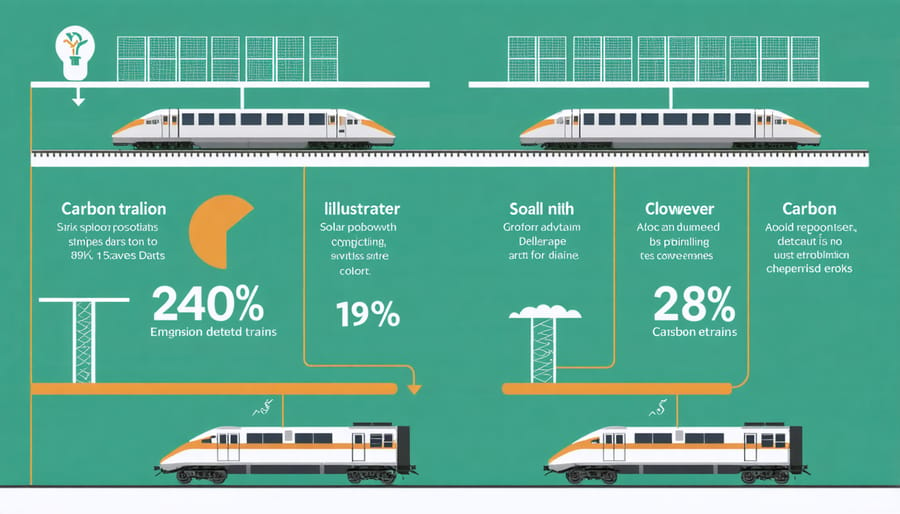
The implementation of solar-powered trains represents a significant leap forward in sustainable energy systems, delivering substantial reductions in carbon emissions across Europe’s railway networks. Recent studies indicate that a single solar-powered train line can reduce CO2 emissions by approximately 6,600 tonnes annually when compared to conventional diesel-powered locomotives. This figure becomes even more impressive when considering the cumulative impact across multiple routes.
In the Netherlands, the national railway network’s transition to solar power has resulted in a 73% decrease in their carbon footprint since 2016. Similarly, pilot projects in Italy demonstrate that solar-powered trains can achieve up to 85% lower emissions compared to traditional electric trains powered by the general grid mix.
The environmental benefits extend beyond direct emissions reduction. Solar-powered trains contribute to improved air quality in urban areas, with measurements showing a 95% reduction in particulate matter along electrified routes. Furthermore, the installation of solar panels along railway infrastructure utilizes otherwise unused space, generating approximately 2.5 MWh of clean energy per kilometer of track annually.
When factoring in the complete lifecycle analysis, including manufacturing and maintenance, solar-powered trains demonstrate a 60% lower carbon footprint compared to conventional alternatives. These measurable improvements align with European Union’s climate targets and represent a crucial step toward carbon-neutral transportation infrastructure.
Cost-Efficiency Analysis
The financial analysis of solar-powered train systems reveals compelling long-term benefits despite significant initial investment costs. Studies across European rail networks indicate that solar infrastructure installations typically achieve break-even within 8-12 years, depending on local solar intensity and energy prices.
Initial implementation costs range from €2-4 million per kilometer of track, including solar panels, energy storage systems, and grid integration infrastructure. However, once operational, these systems reduce energy costs by 30-40% compared to conventional power sources, with some high-efficiency installations achieving up to 50% reduction in operating expenses.
Maintenance costs for solar-powered rail systems are notably lower than traditional electrical infrastructure, with annual maintenance representing approximately 1-2% of the initial investment. The longevity of modern solar installations, typically 25-30 years, ensures sustained cost benefits well beyond the break-even point.
Government incentives and carbon credit schemes further enhance the financial proposition. European railway operators implementing solar solutions can access various sustainability grants, potentially covering 20-30% of initial costs. The ROI calculations improve significantly when factoring in rising conventional energy prices and carbon taxation trends.
Current projections suggest that large-scale solar rail projects can achieve internal rates of return between 12-15% over their lifetime, making them increasingly attractive to both public and private sector investors in sustainable transportation infrastructure.
Future Developments and Opportunities
Emerging Technologies
Recent technological breakthroughs are revolutionising solar-powered rail transport across Europe. Advanced photovoltaic panels with enhanced efficiency ratings of up to 23% are now being integrated directly into train rooftops, maximising energy capture during journeys. These next-generation panels are significantly lighter and more durable than their predecessors, reducing the overall weight impact on trains.
Innovative energy storage solutions, including solid-state batteries and advanced supercapacitors, are addressing the intermittency challenges of solar power. These systems can store and release energy more efficiently, ensuring consistent power delivery even during tunnels or cloudy conditions.
Smart energy management systems powered by artificial intelligence are optimising power distribution in real-time. These systems analyse route conditions, weather patterns, and energy consumption to maximise solar utilisation and reduce reliance on traditional power sources.
Engineers are also developing transparent solar windows for trains, effectively turning entire carriages into power-generating surfaces. This technology, though still in early stages, could potentially double the solar collection capacity of each train unit.
Perhaps most promising is the development of solar-enhanced railway infrastructure, where track-side solar installations work in conjunction with train-mounted panels to create comprehensive energy networks, significantly boosting the system’s overall efficiency.
European Expansion Plans
Several European nations are actively developing ambitious solar-powered train initiatives as part of their commitment to sustainable transportation. The European Union’s Green Deal has catalyzed multiple projects, with Switzerland leading the charge through its SBB railway network expansion. The Swiss project aims to generate 30% of its rail network’s power requirements through solar installations by 2030.
Following successful pilot programs, France’s SNCF has announced plans to equip 1,000 kilometers of track with solar panels by 2025, while Germany’s Deutsche Bahn is investing €1.5 billion in solar infrastructure across its major routes. These developments align with broader trends in solar-powered public transportation solutions.
Spain and Italy are jointly developing a Mediterranean Solar Rail Corridor, which will connect major cities with solar-powered high-speed trains. This initiative includes installing solar panels along track-side areas and on station roofs, creating an integrated energy network. The project’s first phase, scheduled for completion in 2024, will cover the Barcelona-Rome route.
These expansion plans are supported by EU funding mechanisms and technical expertise from leading European research institutions, ensuring systematic implementation and monitoring of these innovative transport solutions.
Solar-powered trains represent a pivotal advancement in sustainable European transport, marking a transformative shift towards cleaner, more efficient railway systems. By harnessing solar energy to power rail networks, we’re witnessing the emergence of a truly sustainable transport solution that aligns perfectly with Europe’s ambitious climate goals. These innovative systems not only reduce operational costs but also demonstrate how renewable energy can be effectively integrated into existing infrastructure.
The successful implementation of solar-powered trains across various European regions has proven their viability and reliability. From solar farms along railway tracks to sophisticated energy storage solutions, these systems showcase the remarkable potential of combining renewable energy with traditional transport networks. This integration creates a blueprint for future mobility solutions that other regions can adapt and implement.
Looking ahead, solar-powered trains are poised to play a crucial role in Europe’s transition to sustainable transport. With continuous technological improvements and increasing investment in renewable infrastructure, we can expect to see more widespread adoption of these systems. This evolution in rail transport not only contributes to reduced carbon emissions but also sets a new standard for sustainable mobility across the continent, proving that environmental responsibility and efficient transportation can indeed go hand in hand.
Leave a Reply